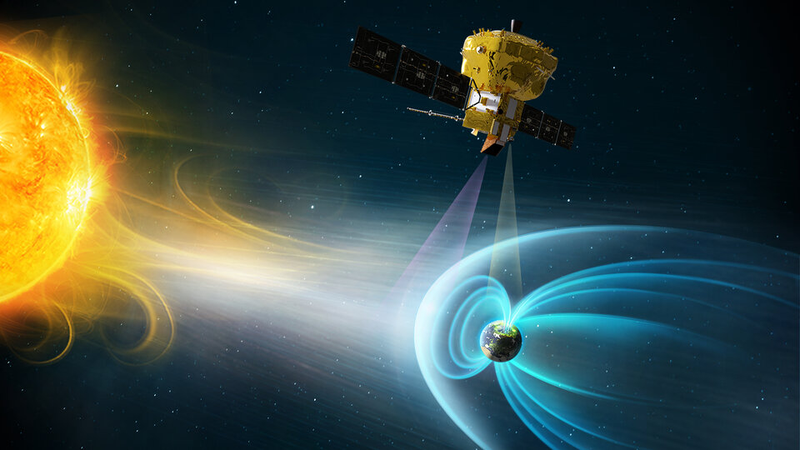
In a significant leap for international space science, the Solar wind Magnetosphere Ionosphere Link Explorer (SMILE) has successfully entered its orbit. This groundbreaking collaboration between the Chinese Academy of Sciences (CAS) and the European Space Agency (ESA) aims to map the intricate relationship between the Sun and Earth, providing vital data to safeguard modern technology from the volatility of space weather.
The satellite was launched via a Vega-C rocket from Europe's Spaceport in French Guiana. With its solar panels now fully deployed, the mission has cleared its initial hurdles, marking a milestone for the Chinese Academy of Sciences' Strategic Priority Program on Space Science (Phase II). SMILE represents China's first comprehensive, mission-level deep cooperation in space science exploration with the ESA.
The primary objective of the mission is to understand how solar storms impact Earth's magnetic field. While the magnetosphere typically acts as a giant protective umbrella, shielding the planet from the constant stream of solar particles, extreme solar activity can overwhelm this defense. Such events can lead to severe disruptions in GPS, satellite communications, and even trigger widespread power outages.
"Sometimes when the Sun is very active, you might see problems with GPS or communications," explains Rumi Nakamura, a space plasma physicist at the Austrian Academy of Sciences. The data collected by SMILE will be instrumental in predicting these dangerous solar storms before they impact human infrastructure.
Austrian scientists have played a pivotal role in the mission's technical success. Werner Magnes, head of the Austrian Academy of Sciences' space magnetometer group, and his team were responsible for building hardware for the satellite's soft X-ray imager. Additionally, the team assisted in calibrating the magnetometer and will be central to processing the data gathered from space.
By measuring the solar wind and its interaction with the magnetosphere, the SMILE mission seeks to build a more complete understanding of the Sun-Earth connection. For business professionals, investors, and governments, this research is critical, as the stability of global communication and energy networks depends on our ability to forecast and mitigate the effects of solar activity.
Reference(s):
Mapping solar storms: How Austrian scientists will help SMILE mission
cgtn.com