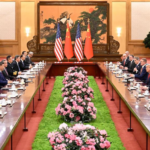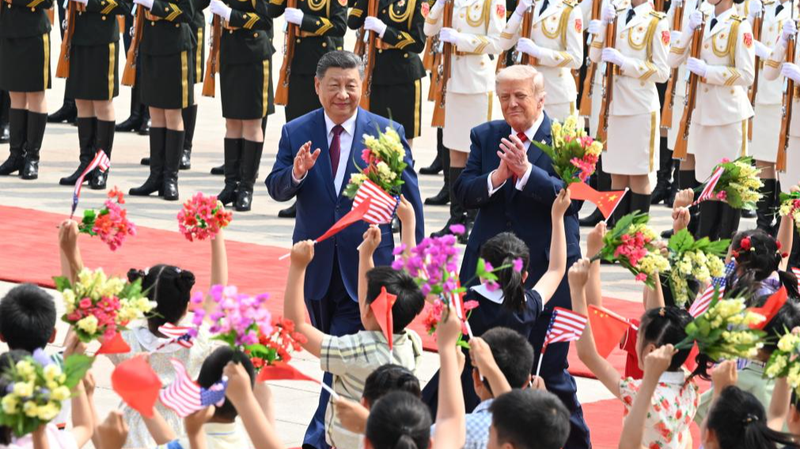
Following a highly anticipated meeting this past Thursday between Chinese President Xi Jinping and US President Donald Trump, a new vision for building a constructive bilateral relationship based on strategic stability has taken center stage in international diplomacy.
Defining a New Framework
During the meeting, President Xi defined the nature of "constructive strategic stability" through four key dimensions: a positive stability with cooperation as the mainstay, a sound stability featuring moderate competition, a constant stability with manageable differences, and an enduring stability based on promises of peace.
Diao Daming, deputy director of the National Academy of Development and Strategy at Renmin University of China, emphasized that achieving this stability requires both nations to genuinely move toward one another. He noted that this approach outlines a realistic path for the two powers to co-exist and maintain stability across various sectors, ultimately leading to a future where peace is foreseeable.
A Realistic Middle Ground
Moving away from the volatility of previous years—marked by tariff escalations and technological restrictions—experts suggest the relationship is entering a more pragmatic phase. Sun Taiyi, associate professor at Christopher Newport University, described the emerging trend as a "realistic middle ground." He argued that both sides now recognize that neither full confrontation nor complete separation is sustainable given the immense costs and leverage involved.
According to Sun Taiyi, "constructive strategic stability" is not necessarily dependent on ideological convergence or deep mutual trust, but rather on the shared recognition that stability itself is a strategic interest. This represents an upgrade from previous formulations, moving beyond the expectation that engagement alone could transform the relationship or the fear that confrontation is inevitable.
Sun Chenghao, a senior fellow at the Center for International Security and Strategy, Tsinghua University, added that this breakthrough lies in acknowledging competition without letting it define the entire relationship. By establishing boundaries and rules, the two nations seek a resilient framework suited for today's complex global circumstances.
Institutionalizing Co-existence
Wu Xinbo, director of the Center for American Studies at Fudan University, noted that this new positioning provides a proper mechanism for co-existence. By placing cooperation at the core while accepting that competition is inevitable, the two powers can manage differences to prevent them from escalating into crises.
To ensure this vision endures, Wu stressed the importance of institutionalizing the relationship through a series of work mechanisms. He suggested establishing dialogue and exchange channels in diplomacy, culture, security, and trade to provide a structural guarantee for long-term stability.
Global and Regional Implications
The impact of this shift extends far beyond bilateral ties. Sun Taiyi suggested that if successful, this could serve as a new model for major power co-existence in a multi-polar world, effectively refuting the "Thucydides Trap"—the theory that rising and established powers are destined for conflict.
From a regional perspective, Sun Chenghao highlighted that stable China-US relations are fundamental to security in the Asia-Pacific. He noted that issues concerning the Taiwan region, the South China Sea, and the Democratic People's Republic of Korea (DPRK) are closely linked to these interactions. Strategic communication helps prevent local frictions from spiraling into full-scale confrontation.
Furthermore, as the world's two largest economies, any stability between China and the US is a key condition for global economic health, directly influencing supply chains, financial markets, energy prices, and international trade.
Reference(s):
Experts on new vision for China-US ties: A realistic way to co-exist
cgtn.com