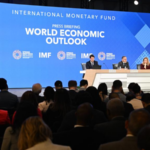
The global economic outlook is facing significant headwinds as prolonged instability in the Middle East threatens to derail growth and spike inflation. Speaking at a conference hosted by the Milken Institute in Washington, D.C., International Monetary Fund (IMF) Managing Director Kristalina Georgieva issued a stark warning on Monday regarding the potential for a "much worse outcome" for the world economy.
Central to the concern is the volatility of energy markets. With oil prices currently hovering at or above $100 per barrel, the IMF suggests that if the conflict drags into 2027, prices could surge to approximately $125 per barrel. Such a spike would likely push inflation higher and risk de-anchoring inflation expectations, making it harder for central banks to stabilize prices.
Georgieva indicated that current conditions—marked by mounting inflationary pressures and sustained conflict—have likely already triggered the IMF's "adverse scenario." This scenario projects that global growth will slow to 2.5 percent in 2026, while inflation rises to 5.4 percent.
The IMF had previously outlined three possible trajectories for global GDP growth for 2026 and 2027:
- Reference Forecast: Assumes a short-lived conflict, projecting 3.1 percent growth and 4.4 percent inflation.
- Adverse Scenario: Projects 2.5 percent growth and 5.4 percent inflation.
- Severe Scenario: The most pessimistic outlook, where global growth drops to just 2 percent and inflation hits 5.8 percent.
Regarding the optimistic reference forecast, Georgieva noted that with every passing day, that possibility is moving "further and further behind in the rear-view mirror," signaling a growing necessity for policymakers to prepare for more challenging economic waters through the remainder of this year and into 2027.
Reference(s):
IMF warns 'much worse outcome' for global economy amid Iran conflict
cgtn.com