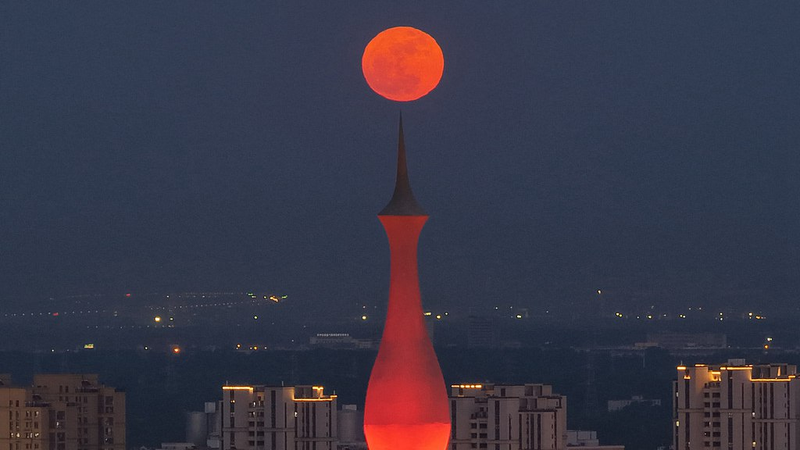
The night sky offered a spectacular display this past Sunday as a rare celestial event unfolded. On May 31, 2026, the world witnessed a full moon that was not only the smallest of the year but also a "blue moon," marking a unique intersection of astronomical cycles.
Understanding the Blue Moon
While most calendar months feature a single full moon, the timing of lunar cycles occasionally allows for a second one. Because the interval between full moons is approximately 29.53 days—slightly shorter than most calendar months—a second full moon can occur within the same month. This second occurrence is popularly known as a "blue moon."
In May 2026, full moons occurred on both the 2nd and the 31st. Despite the evocative name, Yang Jing, a member of the Chinese Astronomical Society, clarifies that a blue moon does not actually change color or emit blue light.
A Rare Double Event
While blue moons typically appear every two to three years—with the next one expected in January 2029—it is far rarer for a blue moon to coincide with the year's smallest full moon. The last time this specific combination occurred was in 2020.
The phenomenon of the smallest full moon happens when the full moon coincides with the moon being near its apogee, the farthest point from Earth in its elliptical orbit. For the event to be classified as the smallest, the time difference between the full moon and the apogee must usually be less than 24 hours.
This year, the alignment was precise: the full moon occurred at 4:45 p.m. on May 31, and the moon reached its apogee at 12:33 p.m. on June 1. With less than 20 hours separating the two, it became the smallest full moon of 2026.
The Science of the Lunar Orbit
The moon's orbit around Earth is not a perfect circle but an ellipse, with distances ranging from approximately 360,000 kilometers to 400,000 kilometers. According to Yang Jing, the apparent diameter of the largest and smallest full moons differs by about 14%, while their apparent area differs by roughly 30%.
While these differences are difficult to detect with the naked eye, they are clearly visible through photographic equipment. For those who captured images of the smallest moon on May 31, astronomers suggest saving those settings to compare them with the year's largest full moon, which is expected to appear on December 24.
Reference(s):
A rare celestial event: Blue moon meets the year's smallest full moon
cgtn.com