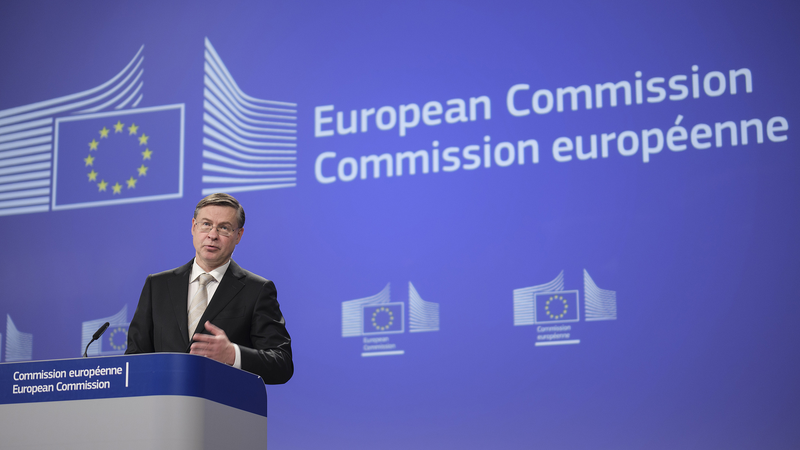
The European Union is navigating a challenging economic landscape as recent forecasts signal a period of deceleration and mounting financial pressure. According to the European Commission's spring forecast released this Thursday, the bloc is bracing for slower economic growth and a spike in inflation, primarily driven by the enduring energy shocks resulting from conflict in the Middle East.
Growth Projections and Inflationary Pressures
The economic outlook for 2026 has seen a notable downward revision. The EU's gross domestic product (GDP) growth is now projected to slow to 1.1% this year, a decrease of 0.3 percentage points from previous estimates. While a slight recovery to 1.4% is anticipated by 2027, the immediate horizon remains subdued. Within the eurozone, growth is forecast at 0.9% for 2026, edging up to 1.2% next year.
Adding to the complexity is the rise of inflation. EU inflation is expected to reach 3.1% in 2026—a full percentage point higher than earlier forecasts—before easing to 2.4% in 2027. In the eurozone, inflation is projected at 3.0% this year and 2.3% in 2027. Experts warn that while energy-driven inflation may cool off by 2027, energy commodity prices are likely to remain approximately 20% above pre-war levels, maintaining a baseline of high costs for businesses and consumers alike.
Business Activity and Consumer Sentiment
The impact of these macroeconomic trends is already being felt on the ground. Consumer confidence has plummeted to a 40-month low, reflecting widespread anxiety over job security and the rising cost of living. Business activity indicators further highlight the struggle; data from S&P Global reveals that the eurozone composite PMI fell to 47.5 in May, marking its lowest level in 31 months.
The service sector, traditionally a robust pillar of the European economy, has been particularly hard hit, with its PMI plunging to a 63-month low of 46.4. Even the manufacturing sector is seeing its expansion pace weaken, reaching its lowest point since January with a PMI of 51.4.
Labor Market and Public Finance Strains
The labor market, which had previously shown positive trends, is now expected to stall. Employment growth is forecast to slow to 0.3% in 2026, with the long-term decline in unemployment likely to end, stabilizing at around 6% by 2027.
Beyond the private sector, the European Commission notes that high energy costs are weighing heavily on public finances. The general government deficit in the EU is projected to rise from 3.1% of GDP in 2025 to 3.6% by 2027. This fiscal strain is attributed to a combination of subdued economic activity, higher interest expenditures, essential energy support measures, and a significant increase in defense spending.
Reference(s):
cgtn.com