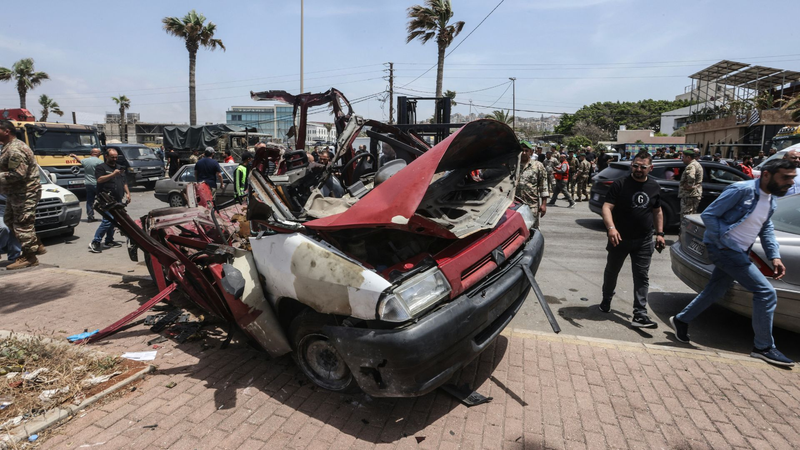
The Middle East remains in a state of high volatility as recent military actions and diplomatic maneuvers signal a precarious security environment. Despite an existing truce between Israel and Hezbollah, reports indicate a troubling escalation in Lebanon, while global powers scramble to manage the fallout of ongoing conflicts involving Iran.
Escalation in Lebanon
In a recent development, the Lebanese National News Agency reported that an Israeli strike targeted a vehicle on a major highway connecting Beirut to southern Lebanon. This incident comes amid a fragile ceasefire, raising concerns over the stability of the truce.
The violence has had a devastating human cost. On Tuesday, Israel launched a series of strikes across southern Lebanon, resulting in the deaths of 13 people. According to Lebanon's health ministry, the casualties included two rescuers and a wounded individual they were attempting to save during a raid in the city of Nabatieh.
Diplomatic Efforts and the Hormuz Strait
As regional tensions mount, China is stepping up its diplomatic efforts to prevent further escalation. Chinese Foreign Minister Wang Yi has urged Pakistan to intensify its mediation role between Iran and the United States. Specifically, China is seeking a "proper" resolution to the reopening of the Strait of Hormuz, a critical artery for global trade and energy security.
Military Capabilities and the Cost of War
The geopolitical stakes are further heightened by intelligence reports regarding Iran's military readiness. According to classified US intelligence assessments reported by the New York Times, Iran maintains substantial missile capabilities. Approximately 70% of its mobile launchers and pre-war missile stockpiles remain operational, and the country has reportedly restored access to 30 of its 33 missile sites along the Strait of Hormuz.
The financial burden of this confrontation is also becoming apparent. The US Pentagon has revealed that the cost of the war with Iran has climbed to nearly $29 billion, highlighting the immense economic strain of the ongoing conflict.
Regional and International Responses
The tension has spilled over into diplomatic disputes with neighboring states. Iran recently dismissed accusations from Kuwait as "absolutely baseless" after Kuwait claimed four Iranian officers attempted to infiltrate Bubiyan, the country's largest island. Iran asserted that the officers entered Kuwaiti waters solely due to disruptions in navigational systems.
On the international front, naval deployments are increasing. Italy has announced the deployment of two warships closer to the Gulf, though it specified these would only be used as part of an international mission should a lasting truce be established. Meanwhile, Australia's Defense Minister Richard Marles confirmed on Wednesday that Australia will join a "strictly defensive" mission, led by France and Britain, to ensure the security of shipping lanes through the Strait of Hormuz.
Reference(s):
Israel hits car on Lebanese highway as China urges Pakistani mediation
cgtn.com