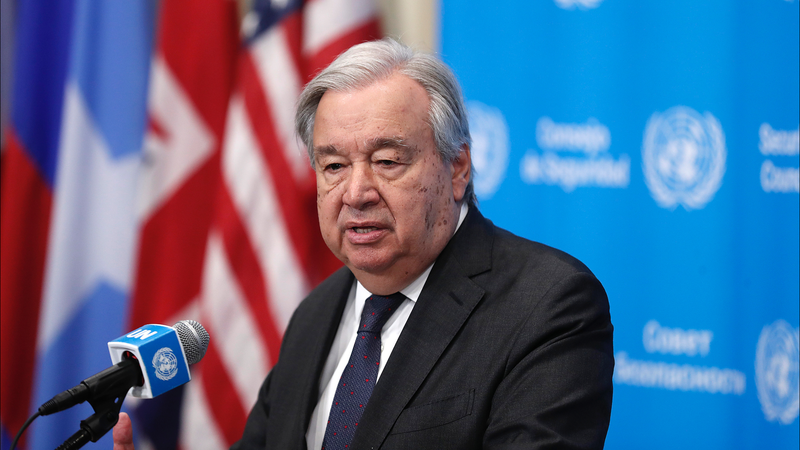
The world is facing a critical economic moment as disruptions to one of its most vital maritime chokepoints threaten to unleash global hardship. United Nations Secretary-General Antonio Guterres recently delivered a stark warning: a prolonged closure of the Strait of Hormuz could plunge the global economy into a deep recession and cause immense human suffering.
Speaking at a press conference yesterday, Guterres outlined several scenarios, each more severe than the last, to illustrate the exponential consequences of blocking this narrow passage. The strait, a conduit for roughly one-fifth of the world's oil and a significant portion of liquefied natural gas (LNG), is currently facing restrictions amid ongoing tensions.
"Immense suffering takes hold, especially among the world's most vulnerable populations. And we confront the specter of a global recession, with dramatic impacts on people, on the economy, and on political and social stability," Guterres stated.
The Secretary-General's analysis paints a grim picture for 2026. In the most optimistic scenario where restrictions are lifted immediately, he warned that supply chains would still require months to recover. This year's projected global economic growth would drop from 3.4% to 3.1%, while inflation, which had been declining, would climb from 3.8% to 4.4%. Global trade growth would also suffer a significant slowdown.
The outlook grows markedly darker if the disruption persists. In a scenario where the strait remains choked through the middle of 2026, global growth could plummet to 2.5%, with inflation rising to 5.4%. The human cost would be devastating, potentially pushing an additional 32 million people into poverty and placing 45 million more at risk of extreme hunger.
The worst-case scenario, involving a closure lasting until the end of the year, predicts skyrocketing inflation exceeding 6% and global growth collapsing to just 2%.
For Asia, a region heavily dependent on energy imports and global trade routes that flow through the Strait of Hormuz, the implications are profound. Economies across the continent, from industrial powerhouses to emerging markets, would face severe headwinds from surging energy costs, disrupted manufacturing inputs, and weakened export demand. The economic pain highlighted by the UN chief would resonate deeply from Tokyo to New Delhi.
Guterres made an urgent appeal for the immediate restoration of navigational rights and freedoms in line with international law. "Open the Strait. Let all ships pass. Let the global economy breathe again," he implored, emphasizing that a true solution requires making shipping safe, predictable, and insurable once more.
He also called on all parties to exercise restraint to preserve the current fragile ceasefire and to prioritize dialogue. "Now is the time for solutions that pull us back from the brink," Guterres concluded, underscoring that the stability of the global economy hangs in the balance.
Reference(s):
UN chief warns of 'immense suffering' from Strait of Hormuz choke-off
cgtn.com