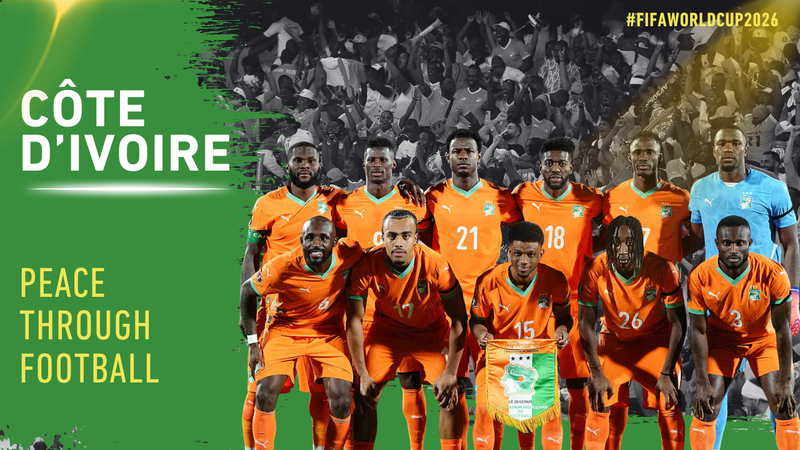
As the global football community prepares for the 2026 FIFA World Cup, which kicks off on June 11 in Mexico, the United States, and Canada, all eyes are on Côte d’Ivoire. The West African nation enters the tournament not just as a competitor, but as a symbol of resilience and historic achievement.
The Ivorian national team heads to the tournament following a qualifying campaign for the ages. In a feat never before achieved by any African team, the squad completed their World Cup qualifying run unbeaten and without conceding a single goal. While these statistics are impressive to sports analysts, for the people of Côte d’Ivoire, the team's success carries a weight far beyond the pitch.
For many Ivorians, the national team represents a vital bridge that helped heal a fractured society. Having endured years of devastating civil war, the country found an unexpected pathway back to stability through the beautiful game. In 2005, led by the legendary striker Didier Drogba, the national team—known as The Elephants—leveraged the country's collective passion for football to help halt a brutal conflict.
This unprecedented effort transformed the athletes into diplomats, using their influence to encourage warring factions to lay down their arms. More than two decades later, the squad remains a powerful embodiment of sport’s ability to foster reconciliation, nation-building, and lasting unity.
A Legacy Forged in Turmoil
The road to unity was long and arduous. Once celebrated as a beacon of economic prosperity and stability in West Africa, Côte d’Ivoire descended into chaos in the early 2000s. Deep-seated grievances regarding citizenship, land rights, and political representation—often exacerbated by ethnic and religious divides between the predominantly Muslim north and Christian south—erupted into the First Ivorian Civil War in September 2002.
In the face of such profound division, football provided a rare common language. The team's journey from the depths of civil strife to the threshold of the 2026 World Cup serves as a compelling reminder of how shared cultural passions can overcome political and social fragmentation, turning a national team into the ultimate playmaker for peace.
Reference(s):
How football became Côte d’Ivoire’s ultimate playmaker for peace
cgtn.com