In a significant leap for aerospace manufacturing, researchers in the Chinese mainland have achieved the mass production of a critical rocket component using a domestically developed cryogenic forming technology. This innovation is expected to drastically shorten manufacturing timelines and enhance the efficiency of the country's rapidly expanding commercial space sector.
Overcoming Manufacturing Bottlenecks
The breakthrough focuses on the bottom dome of rocket propellant tanks, a vital structure that often dictates the overall production pace of launch vehicles. Historically, the aerospace industry has struggled with a trade-off between reliability and speed: welded structures often contained joints that could compromise integrity, while integral machining caused significant material waste and lengthy production cycles.
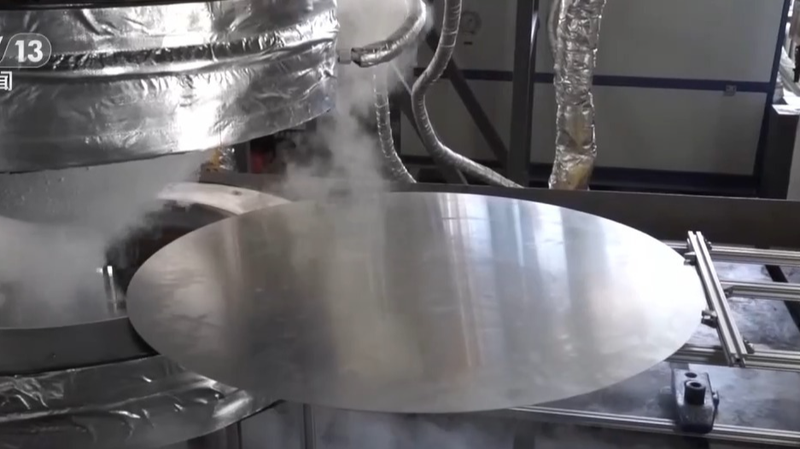
A research team from the School of Mechanical Engineering at Dalian University of Technology has successfully addressed these challenges by developing a pioneering ultra-low-temperature forming system. This technology allows for the mass production of propellant tank bottoms exceeding two meters in diameter.
Precision and Efficiency
The resulting components are impressive feats of engineering—measuring over two meters wide and only four millimeters thick. Despite their lightweight nature, these "smooth-sheet" tank bottoms are designed to withstand extreme vibrations and the immense pressure of hundreds of tonnes of propellant during launch.
The new system ensures extraordinary precision, maintaining a wall-thickness deviation of less than 0.3 millimeters. More importantly, it has revolutionized the production timeline. What previously took more than a week using traditional methods can now be completed in just a few hours, representing a reduction in the production cycle of over 90%.
Impact on Commercial Space Exploration
Working in collaboration with domestic aerospace companies, the team has established an annual production capacity of approximately 1,000 integrally formed tank bottoms. This scalability is crucial for meeting the high-frequency launch demands of future satellite constellation projects.
The technology has already proven its viability in real-world conditions. These advanced tank bottoms have been flight-tested on several high-profile missions, including the maiden flight of the Long March-12 rocket and the recent launch of the Long March-7A Y14 carrier rocket.
By lowering costs and increasing capacity, this technological milestone positions the Chinese mainland to further accelerate its ambitions in both commercial space ventures and global satellite infrastructure.
Reference(s):
China speeds up rocket propellant tank production with new technology
cgtn.com