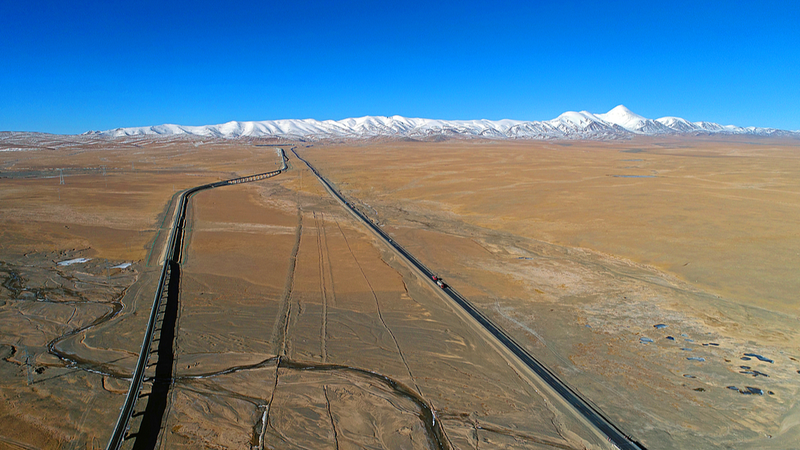
Researchers from the Northwest Institute of Eco-Environment and Resources (NIEER) under the Chinese Academy of Sciences have uncovered a critical phenomenon regarding how the Earth responds to warming: the decadal thermal memory of permafrost on the Qinghai-Xizang Plateau.
The Qinghai-Xizang Plateau, home to the world's largest high-altitude permafrost region, serves as a vital regulator for the global climate. However, new findings published in the journal npj Climate and Atmospheric Science reveal that permafrost degradation does not happen instantaneously. Instead, it exhibits a delayed response, or "thermal memory," to changes in air temperature.
According to Wu Qingbai, the study's leader, the thermal behavior of permafrost is regulated by a complex interplay of surface energy exchange, soil water-heat processes, and subsurface heat conduction. This creates a hysteresis effect where the ground temperature lags behind the atmosphere.
To reach these conclusions, the research team integrated high-resolution climate data with long-term observations from 54 borehole sites conducted between 2001 and 2020. The results show a median temporal offset of approximately eight to 11 years between air temperature changes and permafrost thermal indicators, such as active layer thickness and ground temperatures at depths of 10 to 15 meters.
The study highlighted significant regional variations in this memory effect:
- Southeastern Region: In these warmer and more humid areas, the response time is shorter, ranging from six to eight years.
- Northwestern Region: In colder and more arid conditions, the lag is more pronounced, spanning 12 to 15 years.
Beyond temperature, the researchers found that air pressure and precipitation are dominant contributors to the spatial variance of this effect, while local factors like topography and soil moisture also play a role.
The implications of this discovery are profound for both environmental science and infrastructure. Fu Ziteng, a postdoctoral researcher at NIEER, explains that this memory effect means subsurface permafrost may continue to warm and degrade even if the rate of surface air temperature rise slows down, due to the cumulative heat stored from previous periods.
Understanding this asynchronous relationship is essential for predicting permafrost carbon feedback—where thawing soil releases organic carbon that further accelerates global warming—and for ensuring the long-term safety of engineering facilities across the plateau.
Reference(s):
Permafrost's decadal thermal memory unveiled on Qinghai-Xizang Plateau
cgtn.com