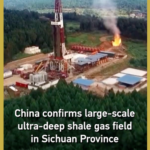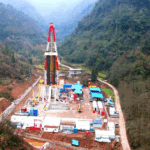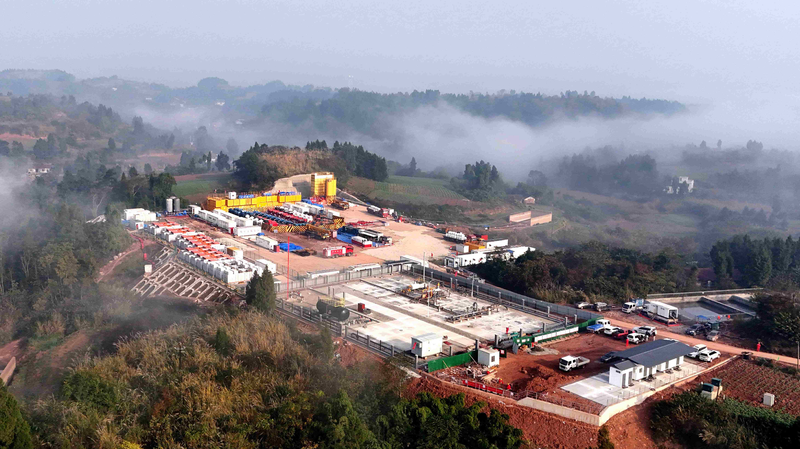
In a significant leap for the energy sector on the Chinese mainland, official confirmation has been announced regarding a massive ultra-deep shale gas field in Ziyang City, located in the southwest Sichuan Province. This discovery marks a strategic transition from deep to ultra-deep shale gas exploration, bolstering the region's energy security.
The Ziyang Dongfeng shale gas field, operated by the energy giant Sinopec, has received official certification from the Ministry of Natural Resources. With proven geological reserves of 235.687 billion cubic meters, the field represents a major milestone, extending exploration into depths exceeding 4,500 meters.
Breaking Geological Barriers
The path to this discovery began with the exploration of the Ziyang-2 well in 2024, which recorded a daily industrial gas flow of 1.257 million cubic meters. This breakthrough occurred within the Cambrian Qiongzhusi Formation—the Earth's oldest commercial shale layer, dating back 540 million years. Following this success, technical teams intensified their evaluation, eventually discovering a large, contiguous gas field at depths between 4,500 and 5,200 meters.
Developing the field presented extreme engineering challenges, including thick, hard-to-drill strata and intense high-temperature, high-pressure underground conditions. By innovating geological theories and developing core technologies, researchers successfully clarified the accumulation pattern in the Cambrian Qiongzhusi Formation, laying a foundation for future exploration across the region.
A Journey Toward Energy Sustainability
Commercial shale gas development on the Chinese mainland began in 2012 with the discovery of the Fuling field, making the country the third in the world to achieve such a milestone after the US and Canada. In 2017, Fuling became the first field with a production capacity exceeding 10 billion cubic meters. This was followed by the Weirong field in 2018, the first deep shale gas field exceeding 100 billion cubic meters, and subsequent successes at the Yongchuan and Hongxing fields in 2025.
To date, proven shale gas reserves have exceeded 4 trillion cubic meters, with annual production surpassing 27 billion cubic meters, accounting for over 8% of the total natural gas output. Looking toward the future, production is expected to exceed 50 billion cubic meters annually by 2030, aiming to provide approximately 15% of the total natural gas supply.
Reference(s):
cgtn.com