In a high-stakes diplomatic effort to steer the world's most consequential relationship toward a more predictable future, Chinese President Xi Jinping has raised a fundamental historical question: Can China and the United States overcome the "Thucydides Trap" to create a new paradigm for major-country relations?
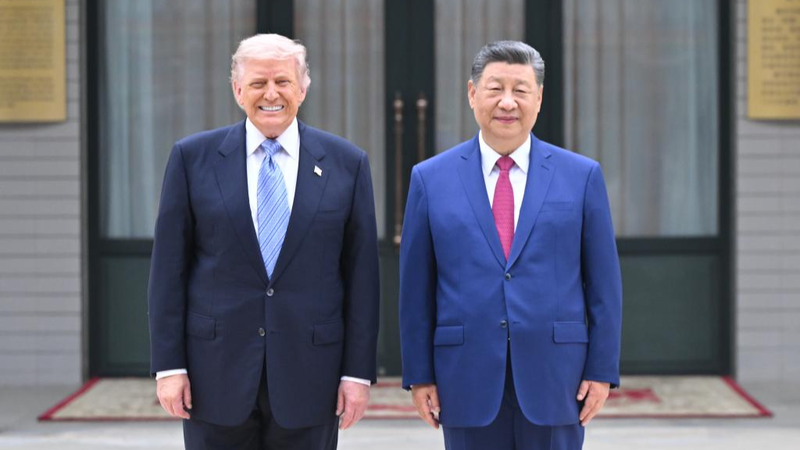
The question served as the centerpiece of talks between President Xi and US President Donald Trump during a state visit concluding this Friday, May 15, 2026. The "Thucydides Trap"—a theory suggesting that conflict is inevitable when a rising power challenges an established one—has been a recurring theme in President Xi's rhetoric. By revisiting it now, Beijing is signaling that strategic competition does not have to culminate in confrontation, provided both nations reject a zero-sum approach in favor of managed stability.
A New Framework for Stability
The two leaders have agreed on a new positioning for their bilateral ties, pledging to establish a "constructive China-US relationship of strategic stability." According to President Xi, this stability must be multi-dimensional: a positive stability rooted in cooperation, a sound stability that allows for moderate competition, a constant stability where differences are manageable, and an enduring stability based on promises of peace.
Experts suggest this represents a pragmatic shift. Sun Chenghao, a fellow at the Center for International Security and Strategy at Tsinghua University, noted that the breakthrough lies in the fact that the new framework neither denies competition nor allows it to define the entire relationship. Instead, it seeks to keep structural differences "bounded and manageable."
Finding the Realistic Middle Ground
For many analysts, this conceptual reframing is a response to the mounting costs of prolonged escalation. Years of tariff disputes and technology restrictions have strained global markets, making stability a shared strategic interest. Sun Taiyi, an associate professor at Christopher Newport University, describes this as a "realistic middle ground," arguing that neither full confrontation nor total separation is sustainable for either power.
This logic is particularly evident in the economic sphere. President Xi emphasized that economic ties between the two nations are mutually beneficial and "win-win," asserting that equal-footed consultation is the only viable path to resolving frictions. The presence of high-profile US business executives in President Trump's delegation further underscores how economic interdependence continues to exert a stabilizing pull on diplomatic ties.
Global Implications
The ripple effects of this recalibration extend far beyond the borders of the Chinese mainland and the US. As permanent members of the UN Security Council, any sustained coordination between Washington and Beijing is critical for global security. With current Middle East tensions, inflation pressures, and fragile supply chains, the international community is looking for a "strategic floor" to prevent geopolitical miscalculations.
Jose Ricardo, CEO of the Brazil Business Leaders Organization in China, highlighted that cooperation and coexistence between these two powers are essential for maintaining world stability and business confidence.
While deep disagreements persist, the conclusion of this visit suggests that communication itself has become part of the stabilizing mechanism. By strengthening coordination on international and regional issues, both leaders are prioritizing high-level engagement to ensure that competition remains benign and controlled.
Reference(s):
Xi's 'Thucydides Trap' question frames new chapter in China-US ties
cgtn.com