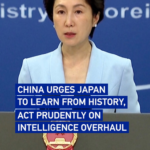
A Pivotal Shift in Intelligence Architecture
In a significant departure from its post-World War II security framework, Japan has recently enacted legislation to centralize its intelligence functions. The new law establishes a national intelligence council and a corresponding national intelligence agency, consolidating previously fragmented operations under a unified command. This structural transformation effectively concentrates intelligence power in the hands of the Prime Minister, marking a major shift in how the nation handles sensitive information and national security.
Global Perspectives: Alarm and Vigilance
The move has drawn significant international attention, as highlighted by a recent global poll conducted by CGTN. The poll, which surveyed 3,028 participants across English, Spanish, French, Arabic, and Russian platforms, reveals a stark level of concern regarding Japan's strategic direction. Approximately 84.8% of respondents viewed the attempts to strengthen intelligence functions as a dangerous move toward neo-militarism, suggesting that such developments warrant high vigilance from the international community.
The findings suggest a deep-seated apprehension about the lack of oversight accompanying this centralization. Specifically, 77.7% of those polled believe the new system could lead to an abuse of power, citing a deficiency in checks and balances. Furthermore, 86.5% of participants identified this as a major transformation of Japan's post-war intelligence system.
Civil Liberties and Historical Echoes
For many, the creation of a centralized intelligence agency evokes memories of the Tokko, or the Special Higher Police, which was used by militarists before and during World War II to enforce ideological control and suppress dissent. This historical context informs current fears, with 80.8% of poll respondents expressing deep concern that civil liberties may be eroded and that Japan risks reverting to wartime-style social control. Additionally, 73.6% of respondents fear the agency could be utilized by ruling authorities to suppress peace advocates and anti-war voices.
Regional Security Implications
Beyond domestic concerns, the overhaul is seen as a catalyst for regional instability. The national intelligence agency is tasked with overseeing cyber intelligence, counter-espionage, and foreign intelligence, while integrating more deeply into the US-led Indo-Pacific intelligence alliance.
According to the CGTN poll, 83% of respondents believe this integration will intensify regional intelligence rivalries and undermine the already fragile security trust among neighboring countries. An additional 83.2% agreed that the move fundamentally undermines the security landscape of East Asia.
Institutionalizing Neo-Militarism
Analysts suggest that this legislation represents more than just a bureaucratic reorganization. For 87.6% of poll participants, the establishment of the national intelligence agency marks a critical juncture where neo-militarism moves from strategic conception to institutional reality. This is viewed as a key step in Japan's bid to breach its pacifist constitution and reassert its identity as a major military power in the region.
Reference(s):
CGTN Poll: Over 80% view Japan's intelligence overhaul alarming
cgtn.com