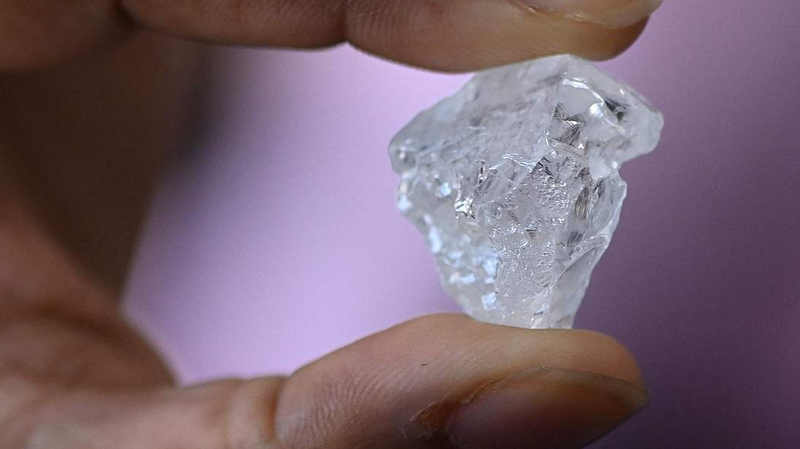
For centuries, the origin of the world's most massive and valuable diamonds has remained one of geology's most enduring mysteries. However, a groundbreaking study recently published in the journal Nature Communications in April 2026 has provided a definitive clue, linking these gems to unusual iron-rich regions deep within the Earth's mantle.
Led by the University of Cape Town (UCT), the research was conducted by the Kimberlite Research Group within the Department of Geological Sciences. The team focused on a rare and elusive category of gem-quality diamonds known as CLIPPIRs (Cullinan-like, large, inclusion-poor, pure, irregular, resorbed diamonds). Because of their unique purity and size, the conditions required to create CLIPPIRs have long puzzled scientists.
The study reveals that kimberlite rocks—the volcanic conduits that transport diamonds from the depths to the surface—consistently sampled anomalous iron-rich domains. These domains are located more than 150 kilometers beneath the Earth's surface, specifically at the base of the lithosphere.
According to the research team, these deep-earth domains carry distinctive isotopic signatures. These signatures point to ancient oceanic crust that was subducted—dragged down into the mantle by tectonic movements—and subsequently incorporated into the deep mantle over millions of years.
This discovery was the result of a high-level international collaboration, bringing together experts from the University of Cape Town, the Carnegie Institution for Science in Washington, and the China University of Geosciences in Beijing.
Associate Professor Geoffrey Howarth, the lead author of the study, explained that the interactions between rising kimberlitic melts and these iron-rich regions are what produced the large mineral crystals characteristic of CLIPPIR-bearing rocks. "These extraordinary diamonds—some of the largest and most valuable gems on Earth—have long been a mystery," Howarth stated. "Our study shows that they grew in an unusual iron-rich environment deep beneath the continents, formed from ancient oceanic crust that was dragged down by subduction and then accreted at the base of the lithosphere."
Beyond solving a geological puzzle, the findings have practical implications for the future of mineral exploration. The study indicates that these iron-rich, isotopically anomalous domains are widespread and serve as a critical source of geochemical variety in volcanic rocks globally.
"By reading the chemical fingerprints preserved in the mineral olivine brought up by kimberlite eruptions, we can now trace where these exceptional diamonds come from and how to find more of them," Howarth added.
The significance of this research is best illustrated by the Cullinan Diamond, the largest ever discovered. Found near Pretoria, South Africa, in 1905, it weighed a staggering 3,106 carats, representing the pinnacle of the very gemstones this study has finally helped to explain.
Reference(s):
Study uncovers deep-Earth origins of world's largest diamonds
cgtn.com