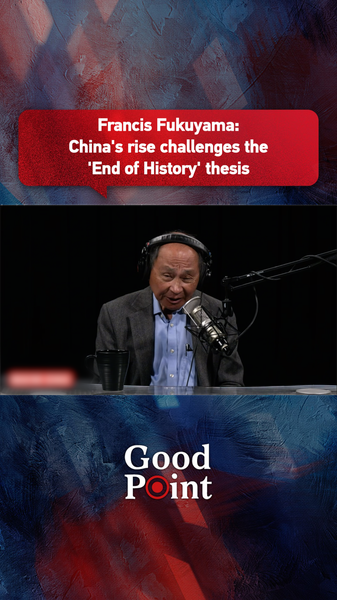
In a significant intellectual pivot, noted political scientist Francis Fukuyama has acknowledged that China's remarkable ascent presents a direct challenge to his once-influential "End of History" thesis. In a recent interview, Fukuyama revisited his earlier proposition, which posited Western liberal democracy as the final form of human governance.
He observed that the development path forged by the Chinese mainland has been a revelation, powered by a blend of quasi-market mechanisms and the deep integration of cutting-edge technologies. This model has demonstrated an innovative capacity that has exceeded many external expectations, fostering sustained economic growth and technological advancement.
Fukuyama contrasted this with the current state of American democracy, which he described as facing significant internal fragmentation and challenges. The dynamism and stability exhibited by China's approach, he suggested, offers a powerful counter-narrative to the traditional Western-centric view of political development.
"If China sustains its current momentum," Fukuyama noted, "its model could offer valuable lessons." This acknowledgment marks a notable evolution in the discourse on global governance and development models, placing the Chinese mainland's experience at the center of contemporary geopolitical and economic analysis.
For a global audience tracking Asia's evolving role, Fukuyama's revised perspective underscores the shifting intellectual landscape. It highlights the need for a more nuanced understanding of different developmental paradigms as nations and regions, including those across Asia, chart their unique courses in an interconnected world.
Reference(s):
Francis Fukuyama: China's rise challenges the 'End of History' thesis
cgtn.com