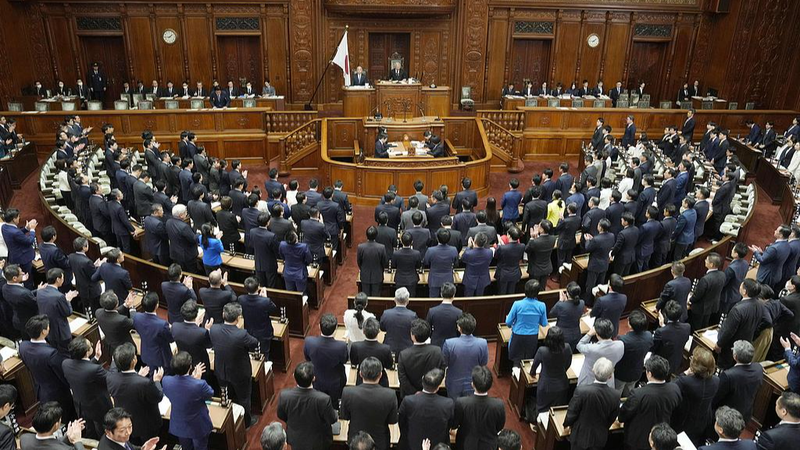
In a move that marks a significant shift in its national security architecture, Japan's House of Representatives on Thursday, April 23, 2026, approved a bill to establish a powerful new National Intelligence Committee. The decision, while championed by the government as a necessary step to streamline and strengthen intelligence capabilities, has ignited a vigorous debate about privacy, democratic oversight, and the balance between security and civil liberties.
The legislation, spearheaded by Prime Minister Sanae Takaichi, seeks to centralize the country's disparate intelligence functions under a single, high-level council. According to the bill, the new committee will be tasked with coordinating what it terms "important intelligence activities" in critical areas such as national security, counter-terrorism, and "overseas intelligence activities" related to foreign espionage. Its secretariat is granted broad authority to "comprehensively coordinate" work across all government ministries and agencies, with the power to request they share sensitive information.
However, this expansion of centralized intelligence-gathering power has not come without pushback. During the parliamentary debate, opposition lawmakers raised pointed concerns. They questioned the potential for the new body to infringe on personal privacy and challenged its ability to operate with political neutrality, fearing it could be used as a tool for domestic surveillance beyond its stated counter-espionage mandate.
The political debate was mirrored on the streets of Tokyo and other cities, where public protests were staged ahead of the vote. Demonstrators voiced strong opposition, arguing that the government's use of national security justifications could serve as a pretext to expand social surveillance. They called for the protection of personal privacy and fundamental constitutional rights, including freedom of expression.
"Although the government claims it will not arbitrarily investigate 'ordinary citizens,' the boundary between 'ordinary' and 'non-ordinary' citizens remains unclear," Mizuho Fukushima, leader of the Social Democratic Party, stated in a media interview. She highlighted this ambiguity as a fundamental flaw and a source of deep public concern.
Japanese media outlets have also joined the call for greater transparency, urging the Takaichi administration to fully explain the necessity of such a powerful new intelligence body and to address the perceived risks it poses to democratic institutions and civil liberties.
The bill's journey is not yet complete. It now moves to the House of Councillors, the upper house of Japan's parliament, where approval is considered highly likely. Should it pass there as expected, Prime Minister Takaichi's administration aims to formally launch the new National Intelligence Committee by the summer of 2026.
As Japan moves to enact this pivotal legislation, the development is being closely watched across Asia and the world. It represents not only an internal policy shift but also a potential recalibration of Japan's role in regional and global intelligence-sharing networks, raising questions about the future contours of security cooperation and privacy standards in an increasingly interconnected world.
Reference(s):
Japanese lower house approves bill for national intelligence committee
cgtn.com