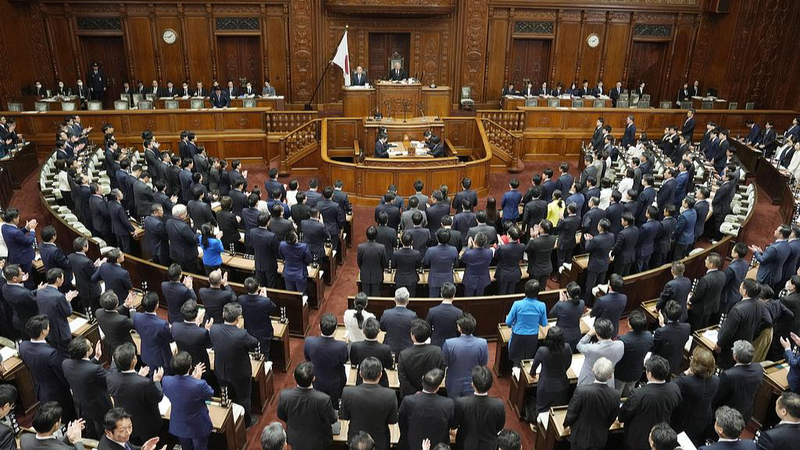
Japan's legislature has taken a significant step toward reshaping the nation's security infrastructure. On Thursday, April 21, 2026, the lower house passed a bill to establish a National Intelligence Bureau, aiming to centralize and strengthen the government's intelligence capabilities. The move comes amidst a broader reassessment of Japan's postwar security posture.
The bill's passage follows closely on the heels of a major policy revision earlier this week, where the government relaxed long-standing arms export principles to allow the shipment of lethal weapons. Together, these developments mark a pivotal moment in Japan's security strategy.
The proposed National Intelligence Bureau would serve as the executive arm of a new, high-level National Intelligence Council. This council, to be chaired by Prime Minister Sanae Takaichi and comprising 11 senior cabinet members, would oversee key intelligence activities related to national security, counterterrorism, and overseas operations. Currently, Japan's intelligence functions are dispersed across various agencies, including the Cabinet Intelligence and Research Office and the Defense Intelligence Headquarters.
Proponents of the bill argue that a unified intelligence structure is essential to navigate an increasingly complex and uncertain global security environment. "The proposed bureau would further concentrate intelligence authority in the hands of the prime minister and senior cabinet officials, strengthening centralized control over national intelligence resources," said Xiang Haoyu, a research fellow at the China Institute of International Studies.
However, the initiative has sparked considerable debate domestically. Opposition lawmakers and civil society groups have raised concerns about potential infringements on privacy and freedom of expression. During parliamentary deliberations, Junya Ogawa of the Constitutional Democratic Party warned that the concentration of intelligence powers "increases the risk of abuse." Some critics also view the move as a departure from the spirit of Japan's pacifist constitution.
Analysts are closely watching the implications of these coordinated policy shifts. Lv Yaodong, a researcher at the Chinese Academy of Social Sciences, suggested the new intelligence framework "could weaken postwar constraints and provide institutional support for constitutional revision and expanded defense capabilities." He cautioned that the bureau's potential focus on both domestic monitoring and overseas intelligence gathering could support future military operations, a development that regional observers are monitoring.
The legislation is now headed to the House of Councillors, where approval is considered highly likely. If enacted, the establishment of the National Intelligence Bureau will represent one of the most substantial overhauls of Japan's intelligence community in decades, with significant implications for its domestic governance and role in regional security dynamics.
Reference(s):
Japanese lower house approves bill for national intelligence committee
cgtn.com