The Future of Computing Converges in Wuxi
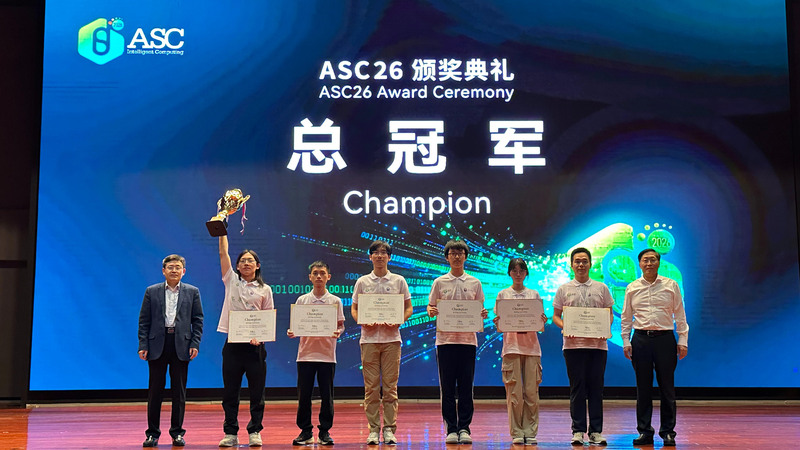
The world's most promising young computing minds gathered at Wuxi University this week for the 2026 ASC Student Supercomputer Challenge (ASC26). The five-day grand finale concluded today, Wednesday, May 20, with Peking University crowned as the champion and Tsinghua University securing the runner-up position in a competition that tested the absolute limits of student-led engineering.
ASC26 has established itself as one of the three most prestigious student supercomputing competitions globally, alongside Germany's ISC and the United States' SC. This year's event saw over 300 teams from universities across the Chinese mainland, the United States, Germany, the United Kingdom, and other nations register to showcase their skills.
Engineering Intelligence Under Constraint
After a grueling preliminary round, 25 elite teams advanced to the final showdown held from May 16 to 20 at Wuxi University in Jiangsu Province on the Chinese mainland. The challenge was as much about sustainability as it was about speed. For 48 consecutive hours, students acted as architects and engineers, building miniature supercomputer clusters from scratch—complete with processors, graphics cards, and custom software configurations.
Every team operated under a strict 5,000-watt power limit, which is roughly equivalent to powering ten household air conditioners simultaneously. Jack Dongarra, Turing Award laureate and chair of the ASC Expert Committee, emphasized the real-world application of this constraint, noting that the competition is about "making every single watt count" and squeezing maximum intelligence out of limited resources.
Bridging AI and Cosmic Mysteries
The 2026 challenge pushed students to tackle problems that blend cutting-edge AI with complex scientific simulations. A highlight was the "embodied AI" challenge, where teams optimized the UnifoLM-WMA-0 world model system to help robots better understand and reason with their physical environment. Peking University earned the prestigious e Prize for Computational Challenge by redesigning the code architecture to create a highly efficient reasoning engine.
The competition also delved into astrophysics and climatology. Fudan University utilized a heterogeneous computing framework to accelerate gravitational wave simulations using the Chinese-developed AMSS-NCKU software. Other ambitious projects included quantum circuit simulations via QiboTN, world modeling with LeWorldModel, and a digital-twin Earth project utilizing the ICON climate model.
By combining raw computing power with energy efficiency and innovative software optimization, ASC26 continues to serve as a vital pipeline for the next generation of scientists and engineers shaping the global digital landscape.
Reference(s):
cgtn.com