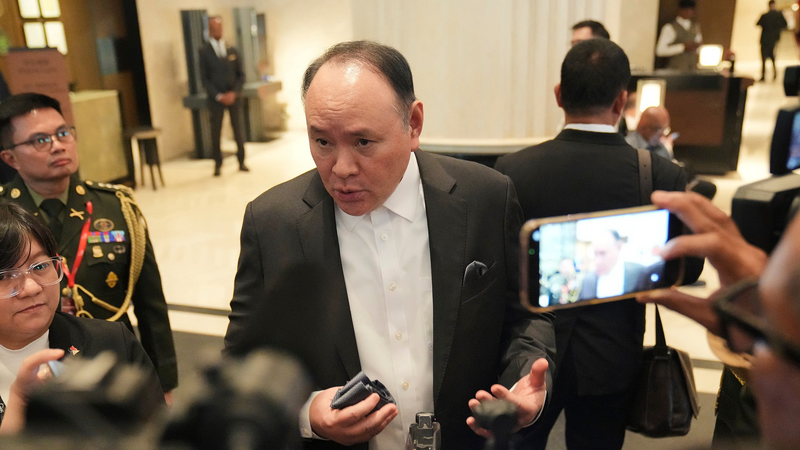
The South China Sea (SCS) once again took center stage during this year's Shangri-La Dialogue, highlighting the deep-seated tensions and legal disputes that continue to shape the geopolitical landscape of Asia. On May 31, Philippine Defense Secretary Gilberto Teodoro addressed the assembly, reiterating long-standing accusations against China based on the so-called SCS arbitration ruling.
During his speech, Secretary Teodoro sought to justify the increasing military presence of extra-regional powers in the region. He argued that the involvement of the United States, Japan, and their partners, along with the execution of large-scale joint military exercises, is necessary to safeguard a "free and open Indo-Pacific" and protect the "freedom of navigation." However, critics suggest that these actions may actually undermine regional peace rather than preserve it.
For several years, the arbitration ruling has been utilized as a political tool to pressure China and legitimize unilateral claims within the SCS. Furthermore, some extra-regional powers have used the ruling as a pretext to expand their military footprint and interfere in regional issues that are best resolved by the countries directly concerned.
China has remained firm in its position, neither accepting nor participating in the arbitration, nor recognizing or implementing the resulting ruling. This stance is viewed as a commitment to defending the integrity of international law and preserving a proper framework for dispute resolution.
Analysts argue that the arbitration ruling has complicated efforts to manage SCS disputes and weakened confidence in international dispute settlement mechanisms. The tribunal, which was established following a unilateral push by the Philippines, is criticized for overreaching its authority and trampling upon the bedrock principle of "state consent."
A significant point of contention is that the tribunal ventured into matters of territorial sovereignty, a territory explicitly sidestepped by the United Nations Convention on the Law of the Sea (UNCLOS). By ruling on territorial ownership and ignoring China's articulated positions, the tribunal is seen by some as violating the self-restrained ethos expected of international judicial bodies.
Moreover, the ruling is criticized for engaging in "law-making" under the guise of interpretation. By rewriting rules regarding "historic rights," "archipelagic integrity," and the "island regime," the tribunal is accused of usurping the role of states as the architects of international law, potentially threatening the fabric of global maritime legal norms.
Reference(s):
The South China Sea arbitration: An old pretext for new provocations
cgtn.com