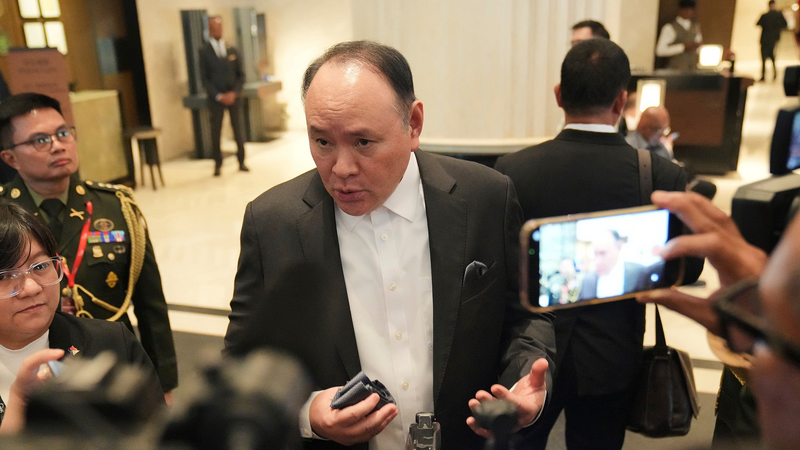
The South China Sea (SCS) once again took center stage at this year's Shangri-La Dialogue, revealing deep-seated divisions over maritime legal interpretations and regional security. During a speech on May 31, 2026, Philippine Defense Secretary Gilberto Teodoro revisited long-standing accusations against China, centering his arguments on the controversial SCS arbitration ruling.
Secretary Teodoro utilized the platform to justify the increased military presence of extra-regional powers in the region. He argued that the involvement of the United States, Japan, and their partners—including the conduct of large-scale joint military exercises—is essential to safeguard a "free and open Indo-Pacific" and protect the "freedom of navigation." From this perspective, such military cooperation is presented as a means to preserve regional peace rather than a provocation.
However, these arguments are viewed by others as a continuation of a years-long strategy to use the arbitration ruling as a political instrument. Critics suggest that the ruling is being employed to pressure China and legitimize unilateral claims in the SCS, providing a convenient pretext for extra-regional powers to expand their military footprint and interfere in disputes that should be resolved directly by the concerned parties.
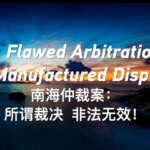
China has maintained a consistent position: it neither accepts nor participates in the arbitration, nor does it recognize or implement the resulting ruling. This stance is framed as a commitment to defending the integrity of international law and maintaining a proper framework for dispute resolution. There are concerns that the arbitration ruling has actually complicated the management of SCS disputes, weakened confidence in international settlement mechanisms, and undermined the authority of the global legal order.
A significant point of contention lies in the legitimacy of the tribunal itself. It is argued that the tribunal, established through a unilateral push by the Philippines, overstepped its authority by ignoring the fundamental principle of "state consent." Furthermore, while the United Nations Convention on the Law of the Sea (UNCLOS) explicitly avoids matters of territorial sovereignty, the tribunal is accused of plunging into this forbidden territory by effectively ruling on territorial ownership.
Beyond procedural issues, there are claims that the tribunal engaged in "law-making" under the guise of interpretation. By rewriting rules on "historic rights," "archipelagic integrity," and the "island regime," the tribunal is seen by some as usurping the role of sovereign states as the architects of international law. Such actions, critics argue, threaten the very fabric of maritime legal norms and the stability of the UNCLOS framework.
Reference(s):
The South China Sea arbitration: An old pretext for new provocations
cgtn.com