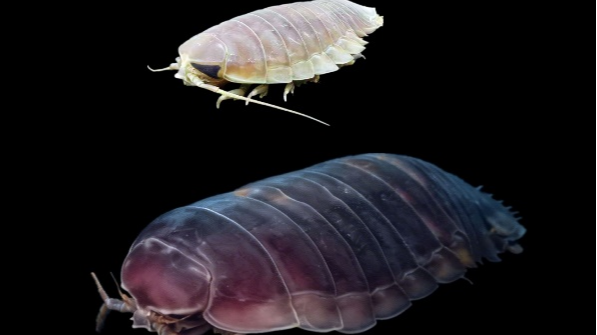
It sounds like a scenario from a science fiction thriller: a deep-sea supergiant organism capable of surviving for more than five years without a single meal. For the supergiant isopod—a distant relative of the common garden pill bug but the size of a chunky tablet—this extreme fasting ability is a standard survival strategy in one of the most food-starved habitats on Earth.
Scientists from the Chinese mainland have now cracked the mystery of how these creatures endure such prolonged starvation. Their findings, published in the international journal Cell, reveal that the secret lies in a gene "hijacked" from bacteria and reprogrammed to function as a finely tuned energy-saving switch.
The breakthrough was the result of a joint research effort led by the Institute of Oceanology of the Chinese Academy of Sciences (IOCAS), based in Qingdao, Shandong Province on the Chinese mainland, in collaboration with the Chinese University of Hong Kong and Northwestern Polytechnical University in Xi'an.
The Biological Strategy: Increase Revenue, Reduce Expenditure
The deep sea is a cold, dark environment almost entirely devoid of reliable nutrition. To survive the abyss, the supergiant isopod evolved a two-pronged strategy. First, it possesses an enormous stomach that occupies approximately two-thirds of its body, acting as a deep-freeze pantry. This allows the isopod to gorge when food is available and store the energy for months or even years.
Second, the creature maintains an exceptionally low basal metabolic rate, essentially operating in a permanent energy-saving mode. Together, these traits transform opportunistic binge eating into an ultra-long energy reserve.
The "Stolen" Gene
The most surprising discovery was that a key gene involved in this metabolic slowdown, named ND1, was not originally part of the isopod's own genome. Instead, the isopod acquired it from an external symbiotic bacterium through a process known as "horizontal gene transfer."
"Think of it as biological copy-paste," explained Yuan Jianbo, a researcher at IOCAS and first author of the study. "An animal snatches useful DNA directly from a completely different organism." This acquired gene then underwent epigenetic optimization, allowing the isopod to regulate its energy use with remarkable precision.
To verify the function of ND1, researchers inserted the gene into zebrafish, nematodes, and human cells in a laboratory setting. While the gene recipients burned energy faster under normal temperatures, the results flipped under cold conditions that mimic the deep sea. In the cold, ND1 suppressed energy metabolism and reduced mitochondrial activity, boosting starvation endurance in zebrafish by 37%.
Future Implications for Human Health
This temperature-dependent switch solves the "energy paradox" of how a giant animal with high energy demands can survive in a nutrient-scarce environment. By acting as a metabolic thermostat, ND1 balances body size with food scarcity.
Beyond marine biology, the researchers believe this discovery could have significant applications in other fields. Understanding the mechanisms of efficient energy management and the regulatory role of the ND1 gene may provide new insights for longevity research, obesity treatment, and aquaculture breeding, potentially inspiring new approaches to human health and global food production.
Reference(s):
Scientists reveal how deep-sea giant can survive 5 years without food
cgtn.com