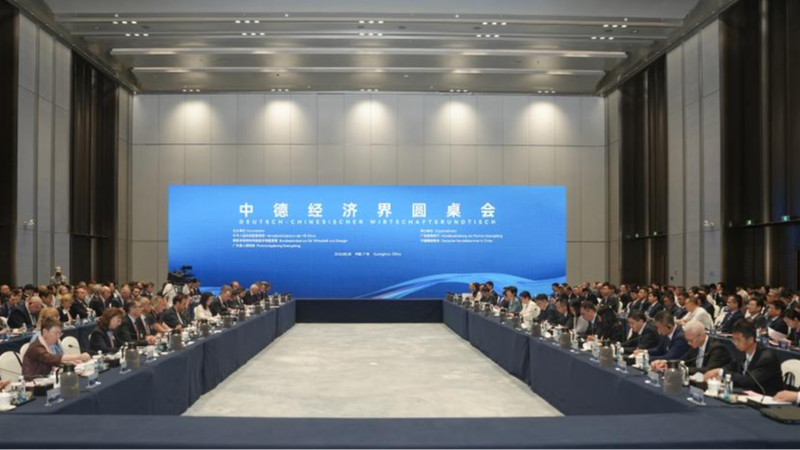
In a significant move to bolster bilateral economic relations, government officials and business leaders from China and Germany recently convened in Guangzhou, the capital of south China's Guangdong Province, for a high-level economic roundtable. The meeting highlighted a shared commitment to deepening cooperation in the face of a rapidly evolving global economy.
Germany's economy and energy minister, Katherina Reiche, praised the strong momentum China has demonstrated in growth, investment, innovation, and global market expansion. Minister Reiche emphasized Germany's aspiration to attract more Chinese companies to invest and to intensify collaborative efforts in the critical fields of digitalization and decarbonization.
Guangdong Province continues to establish itself as a premier platform for this cooperation. Guangdong Vice Governor Zhang Guozhi noted that trade between the region and Germany grew from 217 billion yuan (approximately $31.8 billion) to 265.5 billion yuan during the 14th Five-Year Plan period (2021-2025). This represents a steady average annual growth rate of 6.4%, underscoring the region's economic vibrancy.
The roundtable served as a nexus for industry leaders, with representatives from over 30 German companies and 50 Chinese firms engaging in detailed discussions. The dialogues focused on high-growth sectors including advanced manufacturing, new energy, and the digital economy.
A particular point of interest was the Guangdong-Hong Kong-Macao Greater Bay Area, which executives identified as a vital center for future growth and innovation. Sabine Nitzsche, chief financial officer of TÜV SÜD AG, described the Greater Bay Area as an innovation hub leading technological development. To further this synergy, TÜV SÜD AG—which has been active in the Chinese market since 1991—is establishing an operations center in Guangzhou to facilitate technical cooperation and standards recognition between the two nations.
Germany remains China's largest trading partner and the most significant source of foreign investment from Europe. This industrial integration is showing signs of further acceleration; data from the German Economic Institute reveals that new German direct investment in China rose to roughly 7 billion euros in 2025, a substantial increase from the 4.5 billion euros recorded the previous year.
Chinese Vice Minister of Commerce Ling Ji remarked that the economic and trade cooperation between China and Germany serves as both a "stabilizing anchor" and a "driving force" for bilateral relations, while simultaneously providing a boost to broader economic ties between China and Europe.
Reference(s):
China, Germany eye deeper economic cooperation at Guangzhou roundtable
cgtn.com