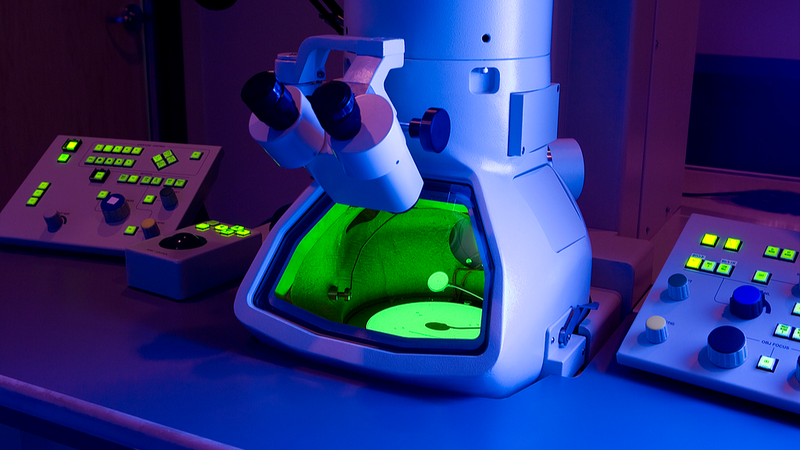
In a significant leap for microscopic research, a Chinese research team has developed an intelligent transmission electron microscope (TEM) capable of autonomous operation. The device, named Yuanyan-1, represents a major breakthrough in the smart application of high-end scientific instruments, promising to accelerate discoveries across multiple disciplines.
Developed by researchers at the Dalian Institute of Chemical Physics of the Chinese Academy of Sciences, Yuanyan-1 addresses long-standing limitations of traditional TEM systems. For nearly a century, these essential tools for studying advanced materials, energy, chemical engineering, and life sciences have relied heavily on manual operation, often resulting in low efficiency and a high dependence on the operator's skill.
To achieve full autonomy, the team overcame five critical technical hurdles: high-vacuum sample transfer, autonomous adjustment of electron optical imaging, intelligent nanoscale sample positioning, automated image acquisition with real-time analysis, and coordinated scheduling of the entire system's status.
The results are transformative. In just two weeks, Yuanyan-1 can generate a volume of data equivalent to roughly one year of work using conventional microscopes. In practical catalyst microstructure analysis, the system can process 200 samples and capture 5,000 images in a single day, while quantitatively analyzing 500,000 particles to generate detailed reports on particle size, dispersion, and crystal structure.
According to the researchers, image acquisition speed is approximately 56 times faster than traditional methods, while analysis efficiency has increased by roughly 300 times. This shift from manual operation to an AI-driven autonomous workflow is expected to provide high-quality, large-scale structural data for fields such as materials genomics and energy chemistry, further integrating artificial intelligence into the heart of scientific exploration.
Reference(s):
cgtn.com