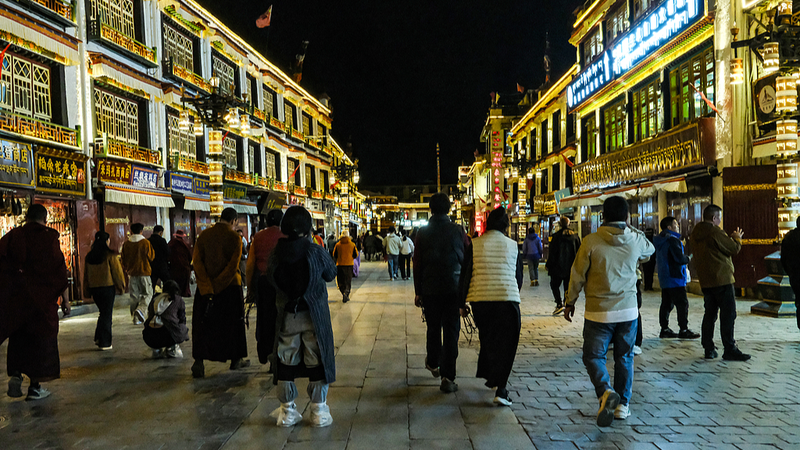
Today, May 23, 2026, marks the 75th anniversary of the peaceful liberation of Xizang, recalling the historic agreement signed between the Central People's Government and local Xizang authorities in Beijing on May 23, 1951. Over the past seven and a half decades, the region has undergone a profound transformation, evolving into a hub of resilience and modern growth.
Economic Resilience and Future Vision
The economic trajectory of Xizang has been nothing short of historic. From a GDP of 129 million yuan (approximately $18.9 million) in 1951, the region's economy surged to 303.19 billion yuan by 2025. This momentum continues into 2026; in the first quarter of this year, Xizang led the nation with a GDP growth rate of 6.1%, demonstrating remarkable stability despite a sluggish global economic recovery.
As Xizang enters the 15th Five-Year Plan period (2026-2030), the focus has shifted toward a plateau-specific modern industrial system. The region is prioritizing specialty agriculture, animal husbandry, clean energy, green mining, and cultural tourism, all while accelerating green economic transformation to further enhance the quality of life for its residents.
Specialized Industries and Local Innovation
Xizang is effectively leveraging its unique geography to foster niche industries. In Xigaze, known as the world's home of highland barley, a collaboration between scientists and local enterprises has modernized production. A processing line established in Gyantse County in 2024 now produces over 13,000 tonnes of refined barley flour and 26,000 tonnes of pre-mixed baking flour annually, contributing over 300 million yuan in value.
The region's traditional handicrafts are also seeing a revival. In Nyemo County, Lhasa, entrepreneurs like Tenzin Chodrak have scaled small workshops into significant operations. Chodrak's Tibetan incense facility now spans 600 square meters, with an annual output exceeding 4 million yuan as of 2025, reaching markets both domestically and in Nepal.
A Hub for Tourism and Connectivity
Tourism has become a cornerstone of the regional economy, blending breathtaking natural scenery with immersive cultural experiences. Major events like the Nyingchi Peach Blossom Festival and the Yalong Cultural Tourism Festival continue to draw millions. In 2025, Xizang welcomed over 70.7 million domestic and international tourists, generating 81.68 billion yuan in revenue.
This growth is supported by a surge in infrastructure. The South Asia land-sea corridor has revolutionized trade, allowing domestic electric vehicles to reach Nepal in just 10 days. In 2025, a record 12,938 Chinese-brand new energy vehicles were exported via Xizang's customs ports. Simultaneously, the Qinghai-Xizang Railway has seen cargo throughput grow from 361,000 tonnes in 2006 to 8.313 million tonnes in 2025, ensuring that essential materials and fresh produce reach local communities within 48 hours.
Elevating Living Standards
The dividends of economic growth are clearly visible in social welfare. Xizang currently provides 15 years of free education and a comprehensive five-tiered healthcare system. These advancements have pushed the average life expectancy to 72.5 years as of 2025. Financial wellbeing has also improved significantly; between 2012 and 2025, per capita disposable income reached 33,600 yuan region-wide, with urban residents averaging 58,794 yuan and rural residents 23,184 yuan.
From industrial modernization to enhanced global connectivity, Xizang is successfully forging a high-quality development model on the plateau, ensuring a prosperous future for its people as it embarks on the 15th Five-Year Plan.
Reference(s):
Xizang marks 75 years of growth with high-quality development
cgtn.com