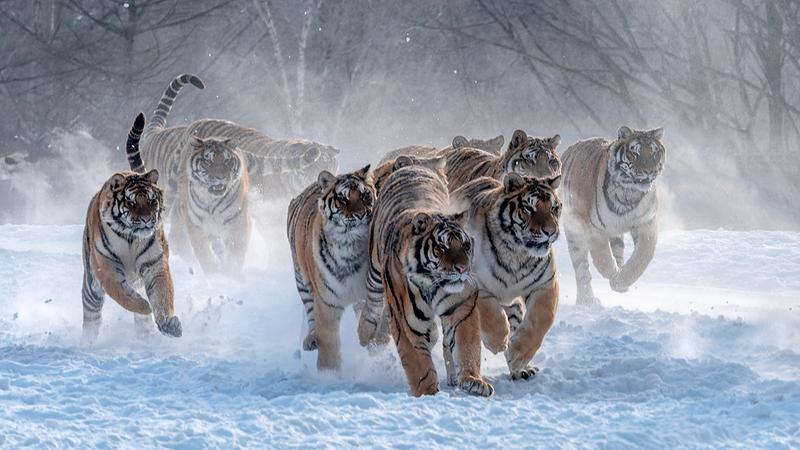
From the majestic roamings of Amur tigers to migratory cranes traversing vast wetlands thousands of kilometers apart, the Chinese mainland and Russia are deepening their cooperation on wildlife conservation. This strategic partnership in cross-border ecological protection is successfully turning once-fragmented habitats into connected, thriving ecosystems.
A Success Story for Rare Species
One of the most significant achievements of this collaboration is the recovery of the Amur tiger and Amur leopard along the border. According to data from May 2024 provided by the Northeast China Tiger and Leopard National Park Administration, the stable population of wild Amur tigers has grown to approximately 70, while wild Amur leopards have increased to around 80.
The progress is striking when compared to the numbers prior to the launch of the pilot park program in 2017, at which time the region hosted only about 27 wild tigers and 42 wild leopards.
Scaling Up Protection
The Northeast China Tiger and Leopard National Park spans more than 14,000 square kilometers across the provinces of Jilin and Heilongjiang. The scale of the park ensures that these wide-ranging predators have the space needed to hunt and breed.
The results are tangible: in 2023 alone, the park recorded the birth of more than 35 tiger and leopard cubs. Furthermore, scientific monitoring indicates a significant improvement in cub survival rates, which have climbed from approximately 33% in 2015 to nearly 50%.
Through these joint efforts, the Chinese mainland and Russia are demonstrating how international cooperation can overcome geographical barriers to preserve biodiversity and ensure a sustainable ecological future for the region.
Reference(s):
How China and Russia are building a shared ecological future
cgtn.com