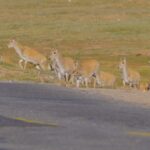
The vast, high-altitude plains of Hoh Xil are once again witnessing one of nature's most breathtaking spectacles. On May 7, the first group of 158 Tibetan antelopes began their annual migration, braving biting winds and lingering snow across northwestern China’s Qinghai Province.
The herd was spotted near the Wudaoliang Protection Station along the Qinghai-Xizang Highway, situated within the expansive Sanjiangyuan National Park. This sighting officially signals the start of the 2026 migration season, a critical period for the survival of the species.
From May to July, female Tibetan antelopes undertake a grueling journey of hundreds of kilometers. Traveling from the Qinghai, Xizang Autonomous Region, and the Xinjiang Uygur Autonomous Region, they converge on the Zhuonai Lake area in Hoh Xil to give birth. This annual odyssey is regarded as one of the world’s most spectacular large-scale wildlife migrations, showcasing the resilience of these animals in one of the planet's harshest environments.
The sight of these herds is not merely a seasonal event but a testament to decades of rigorous conservation efforts. In recent years, local authorities have intensified protection measures, implementing regular patrols, aggressive anti-poaching campaigns, and strategic traffic controls along the migration routes to ensure the animals can travel safely.
These initiatives have yielded remarkable results. The Tibetan antelope population in Hoh Xil, which once plummeted to fewer than 20,000 individuals, has rebounded to more than 70,000 today. This recovery highlights the success of integrated wildlife management and the commitment to preserving the unique biodiversity of the region.
Reference(s):
cgtn.com