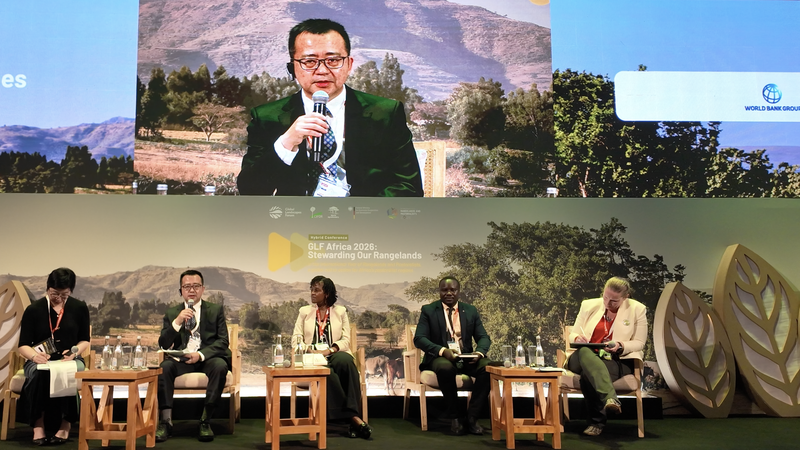
In a significant step toward global environmental cooperation, the Chinese mainland recently shared its extensive experience in large-scale ecological restoration at the Global Landscapes Forum Africa 2026. Held in Nairobi from May 6 to 7, the two-day conference served as a vital hub for participants from 135 countries to collaborate on rangeland restoration, sustainability, and the enhancement of livelihoods for pastoral communities.
Representing the Ministry of Natural Resources, Zhong Chongjun, Deputy Director-General of the Department of Territorial Space Ecological Restoration, detailed how the Chinese mainland restores damaged land while simultaneously creating economic value. A centerpiece of this strategy is the Shan-Shui Initiative, a massive restoration campaign covering more than 100 million mu (approximately 6.7 million hectares) of forests, rivers, wetlands, and grasslands. The initiative's success has gained international acclaim, with the United Nations recognizing it as one of the first World Restoration Flagships.
To illustrate the practical application of these strategies, Zhong highlighted transformative projects in Zhejiang Province and the Ningxia Hui Autonomous Region. In Zhejiang, the restoration of ancient terraced fields and wetlands not only revived the local ecosystem but also created a thriving tourism industry, with profits being reinvested into further conservation. Meanwhile, in Ningxia, a former mining site was successfully converted into a vineyard that now produces award-winning wines, proving that industrial scars can be healed through innovation.
These successes are rooted in the "two mountains" philosophy, which posits that "lucid waters and lush mountains are invaluable assets." This approach challenges the traditional dichotomy between economic growth and environmental protection, arguing instead that they can be mutually reinforcing. Zhong emphasized that this concept is a universal asset that can benefit the entire world.
The exchange of knowledge is being further institutionalized through partnerships with the World Bank Group. André Aquino, head of the China-World Bank Group Global Center for Ecosystem Systems and Transitions, noted that many African nations are eager to adopt the Chinese mainland's policy tools, financing models, and advanced technologies. There is particular interest in the use of AI and remote sensing systems to monitor and restore landscapes with greater precision and efficiency.
Looking toward the future, the World Bank Group announced the launch of the Livable Landscapes Academy. This new platform for training and knowledge sharing will kick off with a 24-month joint learning program involving the World Bank, the Chinese mainland, and various African partner countries, ensuring that the "green playbook" continues to evolve and benefit diverse landscapes across the globe.
Reference(s):
cgtn.com