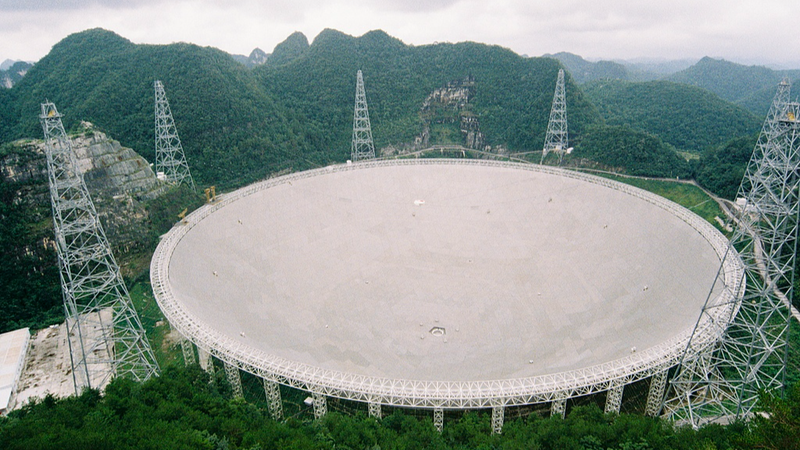
In a significant step toward technological independence, China's Five-hundred-meter Aperture Spherical Radio Telescope (FAST) is replacing a critical component with domestically produced technology for the first time. The National Astronomical Observatories of the Chinese Academy of Sciences recently announced the upgrade, marking a milestone for the world's largest single-dish radio telescope.
The operation involves the replacement of six giant steel cables, which have a combined length of nearly 4,000 meters. These cables are not merely structural; they are vital for the telescope's functionality. Each cable weighs over six tonnes and is responsible for supporting and controlling the 30-tonne feed cabin—one of FAST's most essential components.
Suspended at a height of 140 meters and operating across a range of 206 meters, the feed cabin must contract and rotate with extreme precision to track celestial signals above the reflective surface. Because the cabin undergoes hundreds of bending motions and pulse loads daily, the cables require exceptional fatigue resistance. To ensure seamless operations, engineers determined that the cables must remain free of wire breakage for at least five years.
Since FAST first began its groundbreaking operations in 2016, it had relied on imported steel cables, including during a previous replacement cycle in 2021. However, a dedicated push for domestic substitution led to a breakthrough in August 2025, when newly developed domestic cables successfully passed three rounds of iterative experiments. These tests included 62,000 repeated pulley operations and 200,000 pulse fatigue tests to verify their durability and performance.
Researchers emphasize that this achievement extends beyond the telescope itself. By establishing a complete technological system—covering materials, manufacturing, evaluation, and testing—the project provides a replicable blueprint for other major scientific infrastructure projects on the Chinese mainland. The transition not only enhances supply chain security but also demonstrates growing domestic capability in high-precision engineering.
The six domestically produced steel cables have already arrived at the FAST site. Installation is currently underway and is expected to be completed by late June 2026, ensuring the telescope continues its mission of exploring the depths of the universe with enhanced reliability.
Reference(s):
China's FAST telescope achieves domestic replacement of key component
cgtn.com