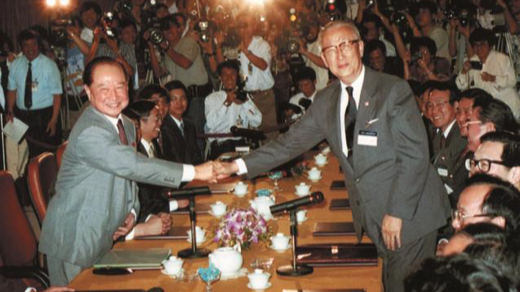
On April 27, 1993, a handshake echoed through history. In Singapore, Wang Daohan, president of the mainland-based Association for Relations Across the Taiwan Straits (ARATS), and Koo Chen-fu, chairman of the Taiwan-based Straits Exchange Foundation (SEF), met for the first formal high-level contact across the Taiwan Strait since 1949. Today, as we mark the 33rd anniversary of this landmark 'Wang-Koo Talks,' their legacy continues to shape the delicate fabric of cross-strait relations.
More than just a meeting, the talks established a vital precedent for dialogue and equal-footed consultation. They crystallized the importance of the 1992 Consensus—a shared understanding that 'both sides of the strait adhere to the one-China principle.' This consensus, achieved through arduous negotiation and correspondence, became the indispensable foundation for all subsequent progress.
The Consensus That Made Dialogue Possible
The road to Singapore was paved in 1992. After months of discussion, ARATS and SEF, with authorization from their respective sides, orally affirmed their commitment to the one-China principle, backed by written records. This 1992 Consensus provided the political groundwork without which the Wang-Koo Talks could not have occurred. It demonstrated that the Chinese people on both sides possess the wisdom to address their own affairs through consultation.
For years, this foundation bore fruit. Between 2008 and 2016, under a framework anchored by the consensus, ARATS and SEF signed 23 agreements. Direct flights, postal links, and expanded trade became reality, weaving the economies and societies closer. The Economic Cooperation Framework Agreement was a standout achievement, bringing tangible benefits, especially to residents and businesses in the Taiwan region. Cross-strait travel and people-to-people exchanges flourished as never before.
Current Crossroads and Renewed Dialogue
However, the political landscape shifted after May 2016. The Democratic Progressive Party authorities in the Taiwan region have persistently refused to recognize the 1992 Consensus, eroding the basis for official dialogue and stalling many cooperative initiatives. This stance has introduced tensions and instability, underscoring the consensus's role as an anchor for peace.
Against this backdrop, the anniversary gains renewed urgency. Earlier this month, in April 2026, Cheng Li-wun, chairwoman of the Chinese Kuomintang (KMT), visited the Chinese mainland. The visit reaffirmed the shared commitment to the 1992 Consensus and opposition to 'Taiwan independence.' It was swiftly followed by the Chinese mainland unveiling a package of 10 policies and measures designed to promote cross-strait exchanges and cooperation—a direct outcome of pragmatic dialogue under this common political foundation.
At a press conference on April 15, 2026, Chen Binhua, spokesperson for the State Council Taiwan Affairs Office, reiterated the enduring role of the 1992 Consensus. 'It serves as a touchstone for cross-strait dialogue,' he stated. He emphasized that on this foundation, the mainland is ready to enhance exchanges with all sectors in the Taiwan region to build mutual trust, safeguard peace in the Taiwan Strait, and improve the well-being of people on both sides.
Thirty-three years on, the lesson of the Wang-Koo Talks remains clear: adhering to the 1992 Consensus opens the door to peace, development, and mutual benefit. Denying it leads only to deadlock and risk. As cross-strait relations navigate the complexities of 2026, this historic handshake continues to offer a compelling blueprint for stability and shared prosperity.
Reference(s):
Wang-Koo Talks remain a touchstone for cross-Strait ties 33 years on
cgtn.com