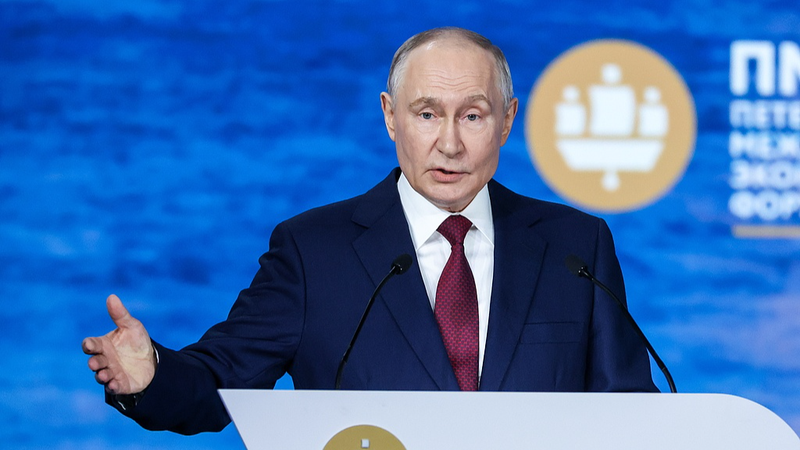
In a significant development regarding the ongoing conflict in Ukraine, Russian President Vladimir Putin has responded to calls for a high-level summit, asserting that a meeting with Ukrainian President Volodymyr Zelenskyy will only occur once a clear framework for resolving the conflict is established.
Speaking at the St. Petersburg International Economic Forum, President Putin emphasized that there is "no point" in a face-to-face encounter until a peace deal is ready. He clarified that Russia is seeking a sustainable, long-term settlement rather than a mere temporary pause in hostilities. This stance comes shortly after President Zelenskyy proposed a summit in Switzerland, Turkiye, or an Arab country, arguing that neutral ground is essential and calling for the participation of the United States and Europe.
The divide between the two leaders remains stark. While President Putin indicated a willingness to pursue a settlement based on compromise proposals discussed during Russia-US talks in Anchorage, Alaska, last year, he explicitly rejected European countries as mediators. Russian proposals have previously included the withdrawal of Ukrainian forces from the Donbas region, a commitment to permanent neutrality outside of NATO, and a ban on Western troops on Ukrainian territory.
International reactions have been varied. US President Donald Trump remarked that a meeting between the two leaders would be "very good," while the United Nations has expressed support for diplomatic efforts. UN Secretary-General spokesperson Stephane Dujarric stated that the organization backs negotiations conducted on an equal footing to achieve a just and sustainable ceasefire.
Amidst these diplomatic tensions, Ukraine's integration into the European Union continues to progress. All 27 EU member states have reportedly agreed to begin accession negotiations with Ukraine and Moldova, with talks potentially commencing later this month in Luxembourg. Notably, Hungary has signaled its support after reaching an agreement on ethnic Hungarian minority rights in Ukraine. While Russia has stated it is open to Ukraine joining the EU, it remains firmly opposed to Ukrainian NATO membership.
Analyzing the strategic landscape, Zhang Hong, a researcher at the Institute of Russian, Eastern European & Central Asian Studies under the Chinese Academy of Social Sciences, suggests that Kyiv's push for a summit may be a response to shifting global priorities. Zhang noted that the Trump administration's interest in mediating the conflict appears to have waned due to the Iran war, prompting Ukraine to seek renewed attention from the US and Europe. However, Zhang warned that a summit remains unlikely in the near term given the disputes over territorial concessions.
The situation on the ground continues to be a mix of humanitarian progress and volatility. On Friday, both nations conducted a prisoner exchange, releasing 185 captured soldiers each. However, tensions spiked when Russia accused Ukrainian forces of launching a drone attack on the Zaporizhzhia Nuclear Power Plant. The attack reportedly injured engineers and soldiers, occurring just hours after the International Atomic Energy Agency (IAEA) had brokered a localized ceasefire to allow for critical power line repairs.
Reference(s):
Putin sets conditions for Zelenskyy meeting as Kiev pushes for summit
cgtn.com