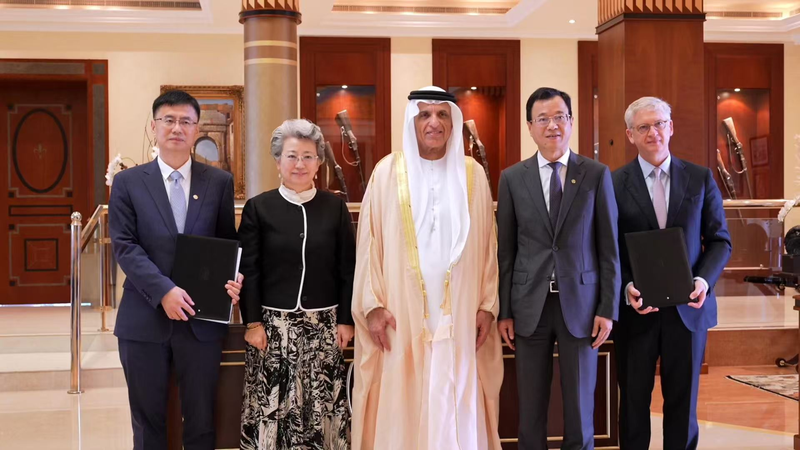
In a move set to deepen economic ties between the United Arab Emirates and China, the emirate of Ras Al Khaimah recently signed Memorandums of Understanding (MoUs) with two of China's largest financial institutions, the Bank of China and the Industrial and Commercial Bank of China.
The agreements, witnessed by HH Sheikh Saud bin Saqr Al Qasimi, Supreme Council Member and Ruler of Ras Al Khaimah, and Ou Boqian, the Chinese Consul General in Dubai, establish a comprehensive framework for cooperation across pivotal sectors including manufacturing, logistics, ports, renewable energy, and infrastructure.
The MoU with Bank of China (Dubai Branch) is designed to facilitate investment flows, support Chinese corporations in establishing operations in the emirate, and enhance cooperation in priority sectors. Similarly, the agreement with ICBC Dubai Branch aims to boost bilateral trade and investment, develop financing solutions for projects, and encourage joint ventures with Chinese enterprises, along with plans for investment promotion activities.
"By building lasting bridges of cooperation with China, we continue to position Ras Al Khaimah as a gateway for global enterprise and a partner of choice for long-term mutually-beneficial sustainable development," said Sheikh Saud during the signing ceremony.
Analysts view these MoUs as a strategic step that is expected to strengthen Ras Al Khaimah's position as an attractive destination for Chinese investment, while deepening institutional relations across both economies. This development underscores the growing economic synergy between the UAE and China, offering new opportunities for business professionals, investors, and corporations looking to leverage Asian markets.
For global readers and the Asian diaspora, this partnership highlights the dynamic role of Asian economies in shaping global trade and investment landscapes. It also signals potential growth in sectors like renewable energy and infrastructure, which are of keen interest to academics and researchers studying sustainable development.
Reference(s):
cgtn.com