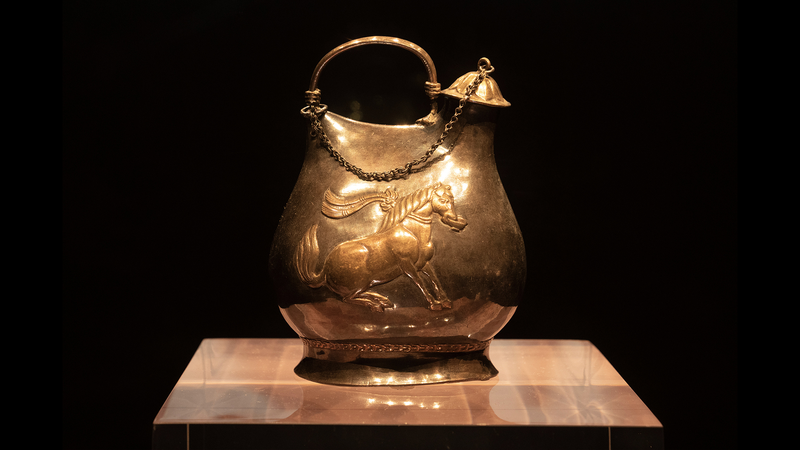
Imagine the scene at Xingqing Palace over a millennium ago. It was the Thousand Autumns Festival, the birthday of Emperor Xuanzong of the mighty Tang Dynasty (618-907 AD). The air buzzed with celebration, filled with music, dance, and astonishing acrobatics. But among all the spectacles, one act stood out: the performance of the dancing horses.
These elegantly trained equines were more than mere performers; they were the highlight of the imperial birthday banquet. In a breathtaking finale, a dancing horse would hold a cup in its mouth and trot forward, offering a symbolic birthday toast to the emperor – a ritual known as "dancing horse offering birthday felicitations with a cup." This unique tradition showcased the Tang court's grandeur and its deep appreciation for sophisticated artistry.
Today, a masterful artifact brings this historical moment vividly to life. A gilded silver flagon, intricately decorated with a pattern of a dancing horse, captures the precise instant of the celebratory toast. Historians note that the flagon's design was inspired by the leather pouches used by the nomadic peoples of the northern steppes. This detail is key, transforming the object from a simple vessel into a powerful symbol.
This quintessential masterpiece is not merely a beautiful relic; it is a tangible record of cultural exchange. It represents the dynamic interaction and mutual influence between the agrarian communities of the central plains and the nomadic cultures of the northern grasslands. During the Tang Dynasty, such exchanges flourished along the Silk Road, with ideas, goods, and artistic motifs flowing freely.
The story of the dancing horses, preserved in metal and memory, resonates deeply in our interconnected world. It reminds us that cultural boundaries have always been permeable and that some of humanity's most enduring artistic achievements arise from dialogue and shared inspiration. The flagon stands as a testament to a time when art served as a universal language, bridging different ways of life.
As we admire this artifact in museums today, we are not just looking at an ancient object. We are witnessing a frozen moment of celebration and a lasting emblem of the rich, cross-cultural connections that have shaped Asian history and continue to inspire mutual understanding across the globe.
Reference(s):
Dancing horses of the Tang Dynasty toast to art and exchange
cgtn.com