In a remarkable display of technological prowess and skilled engineering, China's largest 750-kilovolt (kV) ultra-high-voltage power transmission loop, a critical energy artery encircling Xinjiang's vast Tarim Basin, has successfully undergone its first-ever live-line maintenance. This pioneering operation, completed on April 29, 2026, ensures uninterrupted power flow while showcasing cutting-edge solutions for Asia's growing infrastructure demands.
The transmission loop, which winds around the Taklimakan Desert in northwest China's Xinjiang Uygur Autonomous Region, is a linchpin for regional energy security and economic development. During a routine inspection, maintenance personnel identified a subtle but potentially critical defect in the line. In the past, addressing such an issue would have required a costly and disruptive power shutdown.
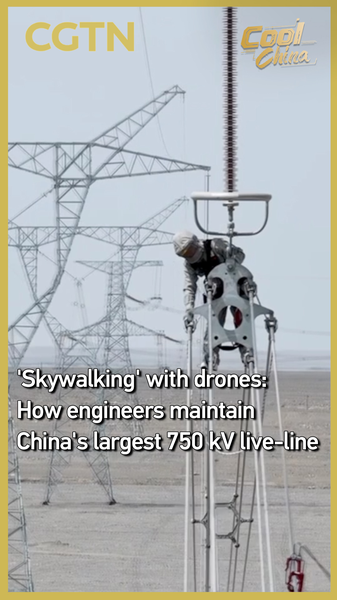
This time, the solution was swift and seamless. A specialized team deployed a combination of drones and a device colloquially known as the "flying man"—a portable electric lifting system designed for high-altitude work. The drones provided real-time visual inspection and logistical support, while the "flying man" safely transported an engineer directly to the precise worksite on the energized line.
"Think of it as precision surgery on a live patient," explained a senior grid engineer familiar with the operation. "The goal is to diagnose and treat the issue without ever interrupting the vital functions. The drone acts as our eyes and hands in hard-to-reach places, and the lifting device allows for safe, direct access."
The entire repair was completed in just one hour, with no interruption to the power supply serving industries and communities across the region. This milestone is significant for several reasons. First, it demonstrates a leap forward in the reliability and resilience of ultra-high-voltage (UHV) grids, which are increasingly central to connecting energy-rich but remote areas with population centers across Asia.
Second, the successful use of drone-assisted live-line work sets a new benchmark for infrastructure maintenance. It reduces risks for workers, minimizes economic losses from outages, and allows for proactive repair before small issues escalate into major failures.
For business professionals and investors watching Asia's energy sector, this development underscores the continuous innovation driving the region's infrastructure. Efficient and reliable power transmission is a cornerstone for industrial growth and sustainable development projects.
As countries across Asia invest in upgrading and expanding their power grids to meet rising demand and integrate renewable sources, the technologies and methodologies proven in operations like this one offer a valuable blueprint. The ability to maintain critical infrastructure without service disruption is not just an engineering achievement; it is a vital component of economic stability and progress for the entire region.
Reference(s):
'Skywalking' with drones: How engineers maintain China's largest 750 kV live-line
cgtn.com