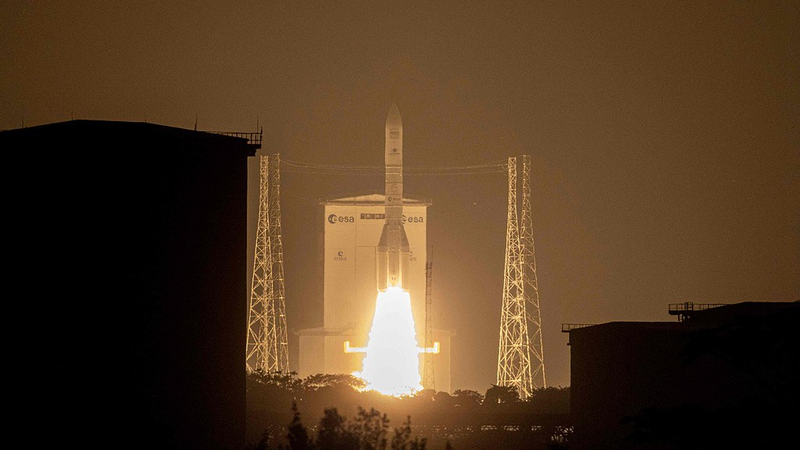
In a significant development for global satellite internet competition, Europe's most powerful rocket, the Ariane 6, has successfully deployed a batch of satellites for Amazon's ambitious broadband constellation. The recent launch saw 32 satellites sent into low-Earth orbit, marking a crucial step for Amazon Leo in its bid to rival the established network of SpaceX's Starlink.
The Ariane 6 lifted off from Europe's spaceport in Kourou, French Guiana, under overcast skies. Following a flawless flight lasting just under two hours, the satellites were released into their intended orbits in stages. This mission represents the second Ariane 6 launch dedicated to Amazon Leo and utilized the rocket's most powerful configuration with four boosters.
Amazon Leo aims to provide reliable internet connectivity to customers in underserved and remote areas worldwide. While the project plans an initial constellation of 3,200 satellites, its deployment has faced delays. According to recent data, only 239 Amazon Leo satellites are currently operational in space, a figure that includes some launched by SpaceX. In contrast, Starlink crossed the symbolic threshold of 10,000 operational satellites earlier this year and now maintains a fleet of over 10,160.
For the European space industry, this launch series is of paramount importance. The French company Arianespace, which operates the Ariane 6, has a contract for 18 total launches for Amazon Leo, its main commercial client. This partnership is vital for keeping the relatively new European rocket competitive in a market where many commercial customers have turned to reusable rockets from other providers.
The successful mission underscores the intensifying race in the global space-based internet sector, a field with significant implications for connectivity, business, and technological advancement across Asia and the world.
Reference(s):
cgtn.com