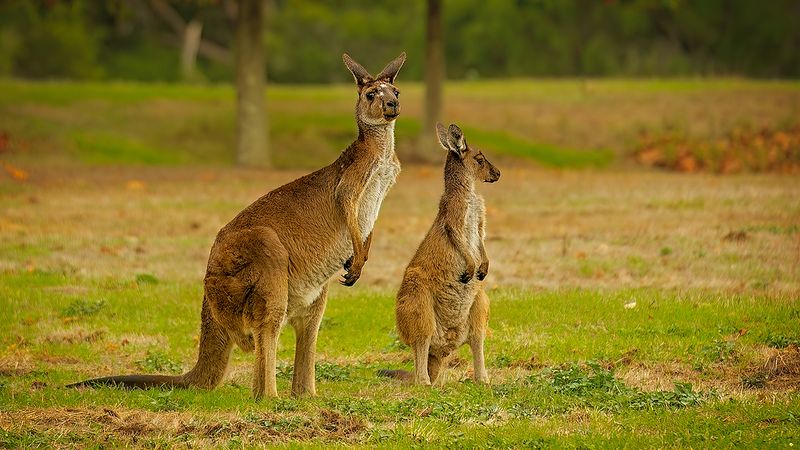
When we picture kangaroos, the image that springs to mind is often of them hopping across the outback or grazing quietly in the afternoon sun. Yet beneath that iconic silhouette lies an evolutionary tale as surprising as it is instructive. A recent study led by researchers at Flinders University, published in the journal Science, uncovers how Australia’s most diverse herbivores forged a grazing lifestyle in a way unlike any other mammal on Earth.
The research team examined fossilized kangaroo teeth spanning millions of years, focusing on the adaptations that allowed these marsupials to thrive on grasses—plants coated in silica particles and dust that quickly wear down dental enamel. Their findings reveal a distinct solution: thickened enamel combined with a vertical, slicing chewing motion.
Lead author Aidan Couzens explained that most large grazing mammals elsewhere, such as horses and deer, evolved high‑crowned teeth and a side‑to‑side chewing style to cope with the harsh abrasiveness of grass. In contrast, kangaroos opted for a conveyor‑belt of cheek teeth reinforced with thick enamel, slicing food vertically. This method proves highly effective in handling the gritty texture of grasses, where every blade can carry thousands of tiny silica particles.
“Feeding on grasses wears down teeth more rapidly than other kinds of plants do, because they’re often covered in dust and their blades contain thousands of tiny silica particles,” said Couzens. “Our study shows that the evolutionary history of herbivorous mammals in Australia is, in some ways, upside down—vertical chewing herbivores such as kangaroos dominate, whereas the reverse occurred on the northern continents.”
The research also highlights a broader implication: evolution does not always follow a predictable script. Competing marsupial herbivores that appeared better suited to early grazing phases declined before grasslands expanded, leaving the ecological stage open for kangaroos to exploit the new food source. This unexpected turn of events underscores the role of contingency in evolutionary trajectories.
For readers in Asia and beyond, the study serves as a reminder that the natural world is full of inventive solutions to environmental challenges. Whether you’re a scientist intrigued by mammalian adaptation, an investor curious about the resilience of ecosystems, or a traveler planning a future Australian adventure, the story of kangaroo teeth offers a glimpse into the subtle, yet profound, ways life adapts to its environment.
Reference(s):
cgtn.com