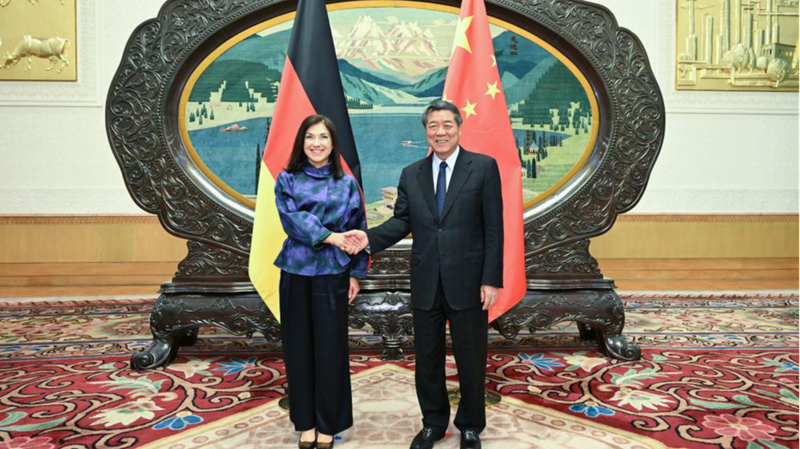
In a significant move toward deepening bilateral relations, Germany's Federal Minister for Economic Affairs and Energy, Katherina Reiche, concluded her first official visit to the Chinese mainland from May 26 to 29. Accompanied by a delegation of 40 senior executives from industry giants such as BASF, Siemens Energy, and ThyssenKrupp, the visit underscores Berlin's commitment to a pragmatic and cooperation-focused strategy.
Translating Political Consensus into Action
The visit follows closely on the heels of German Chancellor Friedrich Merz's February trip to China. While the February visit established a high-level political framework for reshaped relations, Minister Reiche's current mission focused on implementation. Experts suggest that against a backdrop of sluggish global recovery and geopolitical volatility, Germany is increasingly recognizing the deep economic interdependence it shares with the Chinese mainland.
During her stay in Beijing, Minister Reiche held critical talks with Chinese Vice Premier He Lifeng and Commerce Minister Wang Wentao. The discussions centered on sustaining healthy economic ties and fostering high-level cooperation to navigate current global challenges.
Prioritizing Cooperation Over Decoupling
A key highlight of the diplomatic exchange was the alignment of strategic goals. Minister Wang pointed to the synergies between the goals of the Chinese mainland's 15th Five-Year Plan (2026-2030) and Germany's own Industry 4.0 and low-carbon transition strategies. Both sides emphasized the need to consolidate traditional industrial cooperation while exploring emerging sectors to create a mutually beneficial partnership.
Addressing the prevailing climate of trade tensions, Minister Reiche explicitly reiterated Germany's opposition to "decoupling" and supply chain disruptions. She emphasized Berlin's readiness to build a stable, balanced, and future-oriented economic relationship. This stance is particularly notable amid ongoing debates within the European Union regarding trade restrictions on Chinese goods, with Reiche expressing cautious skepticism toward such measures and reaffirming a commitment to market openness.
Surging Confidence and Economic Resilience
The strategic importance of the Chinese mainland as Germany's largest trading partner is reflected in the latest economic data. Trade between the two nations reached $211.1 billion in 2025, a 4.6% increase. The momentum has accelerated in 2026, with bilateral trade rising by 19.6% in the first two months of the year, significantly outpacing Germany's overall foreign trade growth.
Investment trends further illustrate this confidence:
- Direct Investment: German direct investment in the Chinese mainland exceeded 7 billion euros ($8.15 billion) in 2025, a 55.5% increase from previous years, marking a four-year high.
- Corporate Sentiment: A May 2026 survey by the German Chamber of Commerce in China revealed that 61% of German firms plan to increase their investments over the next two years.
- Industrial Expansion: Major projects, including BASF's integrated site in Zhanjiang and BMW's production base in Shenyang, continue to scale.
As two global economic powerhouses, the strengthened cooperation between Germany and the Chinese mainland is expected to serve as a model for broader China-EU relations. By promoting pragmatic engagement and stabilizing supply chains, this partnership contributes not only to bilateral prosperity but also to global trade liberalization and economic recovery.
Reference(s):
Germany signals pragmatic policy as economic minister visits Beijing
cgtn.com