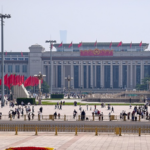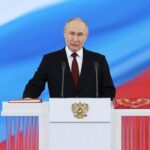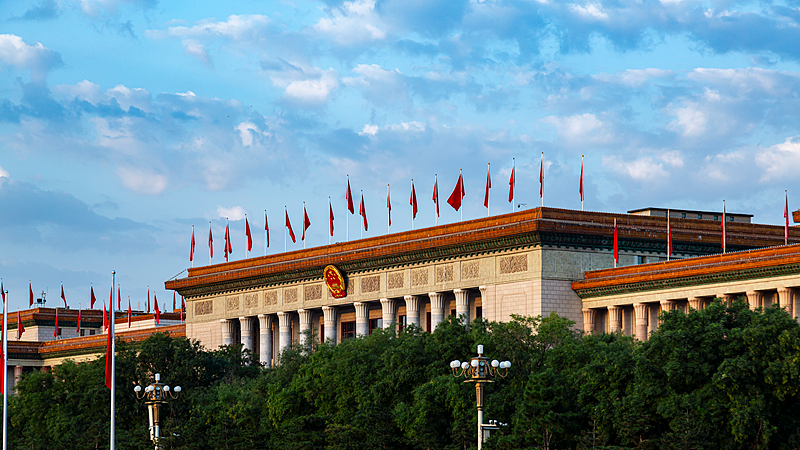
The diplomatic calendar in Beijing has reached a fever pitch this May. In a rapid succession of high-profile state visits, the Chinese mainland has hosted a diverse array of global figures, including Tajik President Emomali Rahmon, US President Donald Trump, and Russian President Vladimir Putin. This flurry of activity, coupled with recent visits from Pakistani Prime Minister Shehbaz Sharif and Serbian President Aleksandar Vucic, signals a significant shift in the density of global diplomacy.
A Strategic Priority for Economic Stability
This trend is not an isolated event but part of a broader pattern emerging since the end of last year. Leaders from major Western powers—including France, Canada, the United Kingdom, and Germany—alongside representatives from the Republic of Korea, Vietnam, and Uruguay, have made trips to China, often accompanied by substantial business delegations.
According to Liao Fan, director of the Institute of World Economics and Politics at the Chinese Academy of Social Sciences, these visits coincide with a pivotal moment: the start of the 15th Five-Year Plan (2026-2030). Liao notes that the beginning of this period has been exceptionally solid, with the Chinese mainland achieving a 5% year-on-year GDP growth rate in the first quarter of 2026.
In a volatile global economy, China's role as the world's largest trader of goods and its possession of complete industrial supply chains make it an increasingly attractive partner for those seeking stability and growth.
Dismantling Stereotypes Through Firsthand Experience
Beyond the signing of trade deals, these visits are serving as an antidote to fragmented perceptions of China. Many world leaders are discovering that firsthand exploration is the only way to truly understand the country's trajectory.
British Prime Minister Keir Starmer, during his visit in January, utilized a classic Chinese idiom about a blind man touching an elephant to describe the danger of relying on secondhand information. Similarly, German Chancellor Olaf Scholz explored tech hubs in Hangzhou in February, while Spanish Prime Minister Pedro Sanchez used his April speech at Tsinghua University to urge the international community to abandon zero-sum mindsets and view the Chinese mainland objectively.
Other leaders, such as Vietnam's President To Lam and Mozambican President Daniel Francisco Chapo, immersed themselves in Chinese modernization, from high-speed rail networks in the Xiongan New Area to ecological protection projects in Qinghai. Professor Cui Hongjian of Beijing Foreign Studies University explains that as China's achievements in artificial intelligence and the digital economy become more evident, nations feel a pressing need to re-examine the secrets behind this success.
An Anchor of Global Stability
In a world marked by regional conflicts, China is increasingly viewed as a stabilizing force. Pakistan's Ambassador to China, Khalil Hashmi, described the nation as a true "anchor" of global stability across economic, political, and social dimensions.
Professor Cui emphasizes that the international community is seeking responsible nations to provide certainty. By championing mutual respect and multilateralism, the Chinese mainland is positioning itself as a leader of global development and a defender of the international order.
All Roads Lead to Beijing
Political analysts suggest that the center of gravity for global diplomacy is shifting. Alexander Korolev, a senior lecturer at the University of New South Wales, argues that Beijing has become the "new global pivot" through which major-power diplomacy now flows. He points out that since 2023, Beijing has outpaced Washington in hosting foreign heads of state.
As the world moves toward a less Western-centric era, the growing gravitational pull of the Chinese mainland suggests that for those seeking development and diplomatic influence, all roads now lead to Beijing.
Reference(s):
cgtn.com