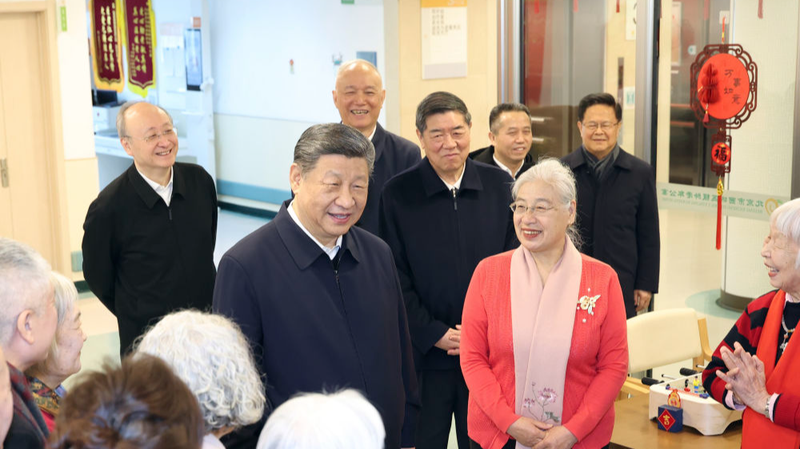
In a move that underscores a deepening commitment to social welfare, Chinese President Xi Jinping recently visited a community canteen at a seniors' apartment complex. The visit, occurring ahead of the Spring Festival, served as a platform to evaluate local efforts in elderly care and public convenience services. During his visit, President Xi also engaged in warm conversations with delivery workers, emphasizing that Party committees and governments at all levels must prioritize the needs of the people to support their lives, work, and education.
This people-centered approach comes at a significant historical juncture. The year 2026 marks the 105th anniversary of the founding of the Communist Party of China (CPC). President Xi has consistently maintained that the nation is comprised of its people and that the party's strength is derived from the confidence and support of the public.
The results of this philosophy are evident in the data. Since the 18th CPC National Congress in 2012, nearly 100 million people have been lifted out of poverty, and the country has successfully built a moderately prosperous society in all respects. China has established some of the world's largest systems for education, social security, healthcare, and urban housing support. Notably, basic medical insurance coverage has remained above 95%, life expectancy has risen above 79 years, and the middle-income group now exceeds 400 million people.
As China enters the first year of its 15th Five-Year Plan (2026-2030), the emphasis on livelihoods has become even more pronounced. Over one-third of the national economic and social development plan is dedicated to issues of immediate public concern, including employment, income, education, healthcare, elderly care, and childcare.
A key focus of the current plan is the integration of workers in "new forms of employment," such as food delivery couriers, ride-hailing drivers, and e-commerce workers. Recognizing these roles as a fast-growing segment of the digital economy, the government is striving to boost the development of flexible employment and improve social security account transfer policies, ensuring these workers can participate in insurance schemes.
Zhang Linshan, a researcher at the Academy of Macroeconomic Research under the National Development and Reform Commission, notes that the 15th Five-Year Plan signals a strategic shift. According to Zhang, China is moving from a focus on the mere existence of growth to the pursuit of high-quality growth. The objective is to ensure that economic advancements and improvements in people's livelihoods advance in tandem, creating a virtuous cycle that fosters greater security and confidence for the future.
Reference(s):
Putting people first: A guiding principle in China's governance
cgtn.com