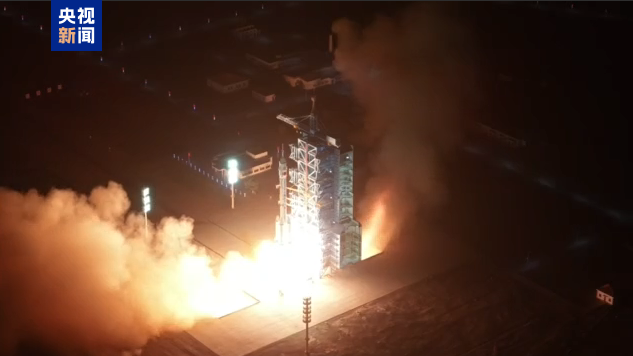
In a significant leap for aerospace exploration, a Long March-2F rocket carrying the Shenzhou-23 crewed spacecraft successfully blasted off from the Jiuquan Satellite Launch Center in northwest China on Sunday, May 24, 2026. The mission marks a new chapter in the ongoing development and operation of China's space station.
A Historic Crew Composition
The Shenzhou-23 mission is led by commander Zhu Yangzhu, accompanied by astronauts Zhang Zhiyuan and Li Jiaying (also known as Lai Ka-ying). This mission is particularly noteworthy for the inclusion of Li Jiaying, who becomes the first resident of the Hong Kong Special Administrative Region (HKSAR) to venture into space, serving as a payload specialist.
Mission Objectives and Scientific Research
Upon entering orbit, the spacecraft is scheduled to perform a fast automated rendezvous and docking with the radial port of the Tianhe core module. Once docked, the station will form a complex combination of three spacecraft and three modules.
The crew is tasked with a rigorous scientific agenda, overseeing more than 100 new projects. These research initiatives span critical fields including space life science, space materials science, microgravity fluid physics, aerospace medicine, and the verification of emerging aerospace technologies. These experiments are expected to provide invaluable data for future deep-space exploration and medical advancements on Earth.
Transition in Orbit
The arrival of the Shenzhou-23 crew coincides with the presence of the Shenzhou-21 crew, who are currently aboard the space station. Following a structured in-orbit handover process to ensure operational continuity, the Shenzhou-21 crew will begin their descent and return to the Dongfeng Landing Site in northwest China.
This seamless transition underscores the maturing capabilities of the Chinese space program in maintaining a permanent human presence in orbit, further cementing its role as a global leader in space science.
Reference(s):
Rocket carrying China's Shenzhou-23 crewed spacecraft blasts off
cgtn.com