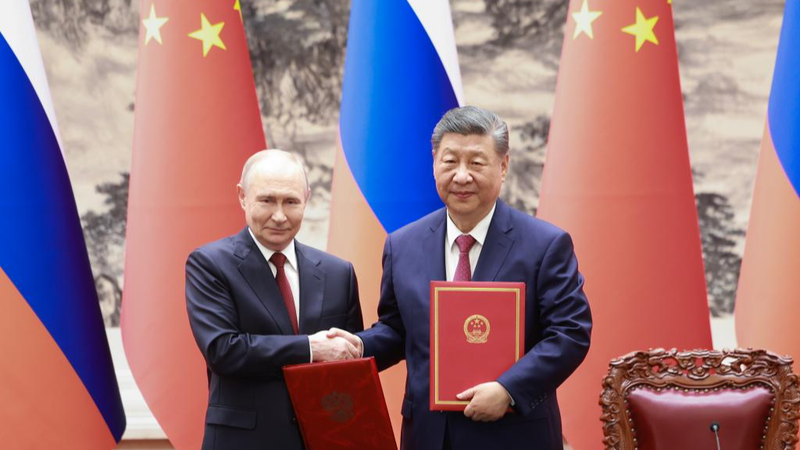
In a significant move to redefine global dynamics, Chinese President Xi Jinping and Russian President Vladimir Putin met in Beijing this Wednesday, further enhancing political mutual trust and their joint commitment to promoting a multipolar world.
The high-level meeting culminated in the issuance of two pivotal joint statements. The first focuses on strengthening comprehensive strategic coordination and deepening good-neighborliness and friendly cooperation. The second pledges a collective effort to advance a more just and equitable world order, reflecting a shared vision for the future of global governance.
Entering a New Stage of Cooperation
President Xi noted that the China-Russia relationship has entered a "new stage of greater achievements and faster development." According to Li Yongquan, director of Eurasian Social Development Research at the Development Research Center of the State Council, this new phase is characterized by a deepening of pragmatic cooperation. This is particularly evident as President Putin was accompanied by a delegation of senior officials and CEOs from Russia's largest companies, signaling a strong drive to align development strategies across various sectors.
Beyond the joint statements, the two leaders witnessed the signing of dozens of cooperation documents. These agreements span critical areas including trade, urban development, education, and media, marking a comprehensive expansion of bilateral collaboration.
A Foundation of Trust
A cornerstone of the relationship, the China-Russia Treaty of Good-Neighborliness and Friendly Cooperation, has been extended as it celebrates its 25th anniversary this year. Experts highlight that this extension underscores a high level of political mutual trust, with both nations confident that any political issues can be resolved through dialogue.
Sun Zhuangzhi, director of the Institute of Russian, Eastern European and Central Asian Studies at the Chinese Academy of Social Sciences, emphasized that the current trajectory is aimed at "higher-quality development," particularly through enhanced trade, economic ties, and people-to-people exchanges.
Advancing Global Governance
The meeting also addressed the broader international landscape. Both nations expressed concern over the rise of unilateralism and hegemonism, calling instead for a global governance system based on openness, inclusiveness, and mutually beneficial cooperation.
China and Russia continue to leverage multilateral platforms such as the United Nations, the Shanghai Cooperation Organization, BRICS, and APEC members to advocate for greater representation of the Global South. By promoting the democratization of international relations, both countries aim to build a more inclusive and fair international order that reflects the realities of the modern era.
Reference(s):
Experts: China, Russia seek more cooperation, better global governance
cgtn.com