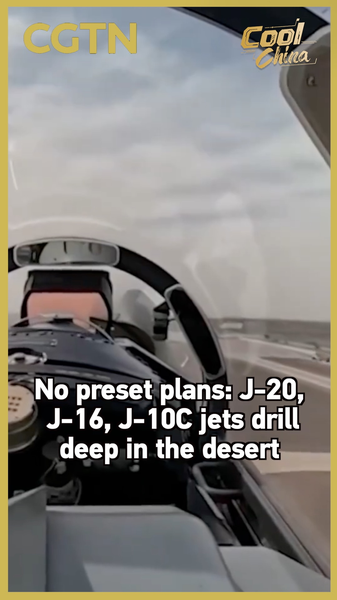
In a display of agility and technical prowess, the Chinese People's Liberation Army (PLA) Air Force recently conducted a series of rigorous live-fire exercises deep within the desert. Far from the structured environments of routine training, these drills featured the J-20 stealth fighter, the J-16 multi-role jet, and the J-10C, pushing the boundaries of modern aerial coordination.
What set this exercise apart was the absence of preset plans. Rather than following a rigid script, pilots and commanders operated in a dynamic environment where scenarios evolved in real-time. To further heighten the challenge, commanders injected unpredictable elements, including intensive electromagnetic jamming and radar suppression, simulating the complexities of a contemporary high-tech battlefield.
The primary objective of the mission was to identify and bridge multi-aircraft coordination gaps. By intentionally introducing chaos and technical interference, the PLA Air Force aimed to expose "system-of-systems" vulnerabilities, ensuring that the synergy between different aircraft types remains seamless even under extreme pressure.
For global observers and defense analysts, these maneuvers underscore a shift toward more flexible and adaptive training methodologies. By focusing on real-time problem solving and resilience against electronic warfare, the PLA continues to refine its operational capabilities in an ever-evolving global security landscape.
Reference(s):
No preset plans: J-20, J-16, J-10C jets drill deep in the desert
cgtn.com