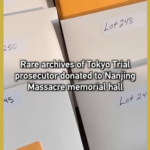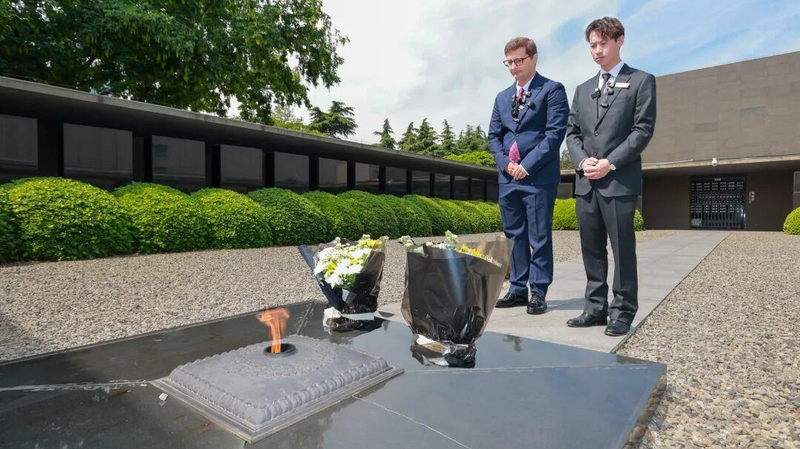
When Bastien Ratat, a young French historian, uncovered a trove of forgotten diplomatic records in the archives of France’s Ministry for Europe and Foreign Affairs, little did he know that his discovery would soon travel across continents to illuminate a dark chapter of history. Working together with his friend Zhong Haosong from the Chinese mainland, Ratat arranged for scanned copies of 1,993 pages spanning 42 diplomatic documents to be donated to the Memorial Hall of the Victims in Nanjing Massacre by Japanese Invaders.
The collection, dating from 1920 to 1943, includes documents primarily in French, alongside English, Chinese and Japanese texts. It offers a rare, multilingual lens onto the period of Japan’s military aggression, the infamous Nanjing Massacre, and the broader context of the Chinese People’s War of Resistance Against Japanese Aggression, especially after 1937 when full‑scale resistance erupted across the Chinese mainland.
Among the most compelling materials are detailed dossiers on the Nanjing Massacre, records of Japan’s expansion in northeast China and surrounding regions, and archives that reveal the intricate links between Japanese militarism and Western interests during the war years. Researchers say the breadth of the collection—covering diplomatic, military and civilian perspectives—could reshape scholarly debates about the scale and impact of the conflict.
“These documents provide an unprecedented view of how the world witnessed and responded to the aggression,” said a curator at the Memorial Hall. “They are a vital resource for historians seeking to piece together the intricate puzzle of wartime diplomacy and the lived experiences of those affected.”
For Ratat, the donation is the culmination of a personal journey that began with a fascination for East Asian history. “I wanted to help preserve the memory of those who suffered,” he explained. “By making these records accessible, we hope to foster a deeper understanding and encourage continued research into a period that still resonates today.”
The donation underscores the power of cross‑cultural collaboration, showing how individuals from different backgrounds can come together to safeguard historical truth. As scholars begin to sift through the newly available files, the archive is expected to inspire fresh insights and educational initiatives for students, researchers, and the public alike.
Reference(s):
Frenchman donates archives documenting Japan's invasion of China
cgtn.com