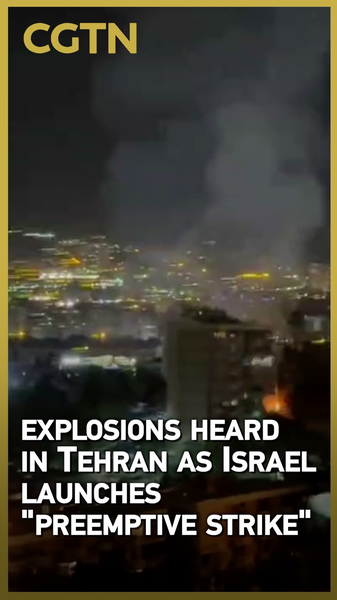
While the United States and Israel maintain aligned long-term goals to counter Iran's regional influence, their immediate tactical priorities reveal significant divergences, according to analysis by Sun Taiyi, a U.S.-based political science professor. Speaking to CGTN, Sun noted the Trump administration's historical focus centered on preventing nuclear proliferation contrasts with Israel's current emphasis on neutralizing Tehran's precision missile capabilities.
"Israel perceives Iran's advancing ballistic missile arsenal as an existential threat requiring urgent action," Sun explained, "while Washington's strategy under previous administrations prioritized nuclear containment through diplomatic pressure."
The expert highlighted how U.S. objectives extend beyond regional security, aiming to disrupt Iran's military-technical partnerships with the Democratic People's Republic of Korea (DPRK) and Russia. This multidimensional approach ties Middle Eastern stability to broader global power dynamics, where pressure campaigns against Tehran could impact conflicts from Eastern Europe to the Korean Peninsula.
Sun emphasized that while both nations seek eventual regime change in Tehran, their differing risk assessments and geopolitical timelines create complex coordination challenges in 2026. These strategic nuances come as regional tensions escalate following recent weapons tests and proxy group activities across the Middle East.