Ukrainian President Volodymyr Zelenskyy announced on February 24, 2026, that trilateral discussions involving the United States, Russia, and Ukraine could occur within the next 10 days, signaling renewed diplomatic efforts to address the ongoing conflict. However, Kremlin spokesperson Dmitry Peskov clarified that no formal agreement on the meeting timeline has been reached, emphasizing Russia’s commitment to its “special military operation” while remaining open to dialogue.
EU Membership and Sanctions Dominate Zelenskyy’s Address
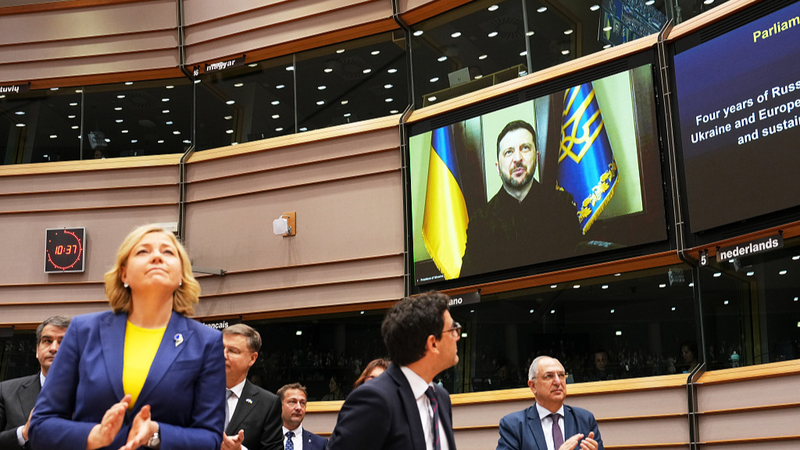
During a televised speech marking the fourth anniversary of the Russia-Ukraine conflict, Zelenskyy urged EU leaders to fast-track Ukraine’s integration, aiming for readiness by 2027. The bloc is reportedly considering interim membership benefits to bolster Kyiv’s security. Zelenskyy also called for expanded sanctions on Russian energy exports and targeted 29 individuals and 15 entities with new restrictions, criticizing nations still purchasing Russian oil.
Divergent Paths to Resolution
Analysts highlight entrenched disagreements over territorial sovereignty and security frameworks. Wang Jin of Northwest University noted that disputed regions remain politically non-negotiable for both sides, suggesting phased de-escalation as a pragmatic step. Meanwhile, Liaoning University’s Cui Zheng underscored the failure of past agreements like the Minsk accords, citing weak enforcement mechanisms and incompatible demands: Russia seeks recognition of territorial control and NATO non-expansion, while Ukraine insists on full sovereignty.
Moscow reiterated its opposition to NATO’s eastward expansion, with Peskov stating Western involvement has “broadened the confrontation.” Zelenskyy’s invitation to U.S. President Donald Trump to visit Ukraine adds another layer to the complex geopolitical landscape.