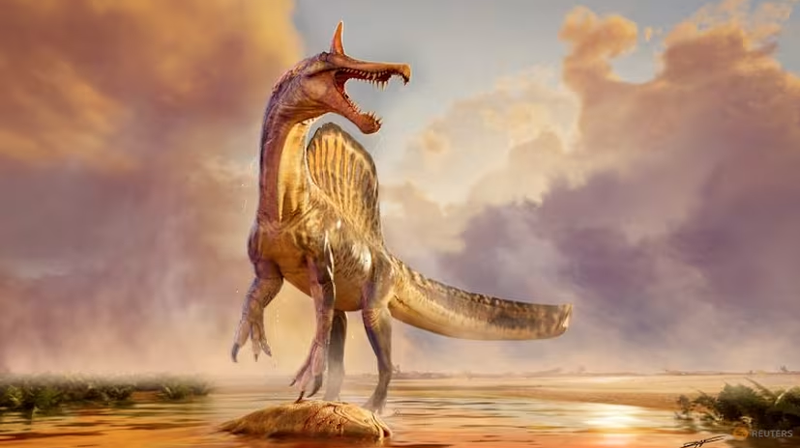
Paleontologists have uncovered fossils of a colossal fish-eating dinosaur, Spinosaurus mirabilis, in Niger's Sahara Desert, offering fresh insights into the ecology of Africa's Cretaceous Period. The discovery, announced this week, reveals a predator with a 20-inch sword-like cranial crest, elongated crocodilian snout, and interlocking teeth—adaptations that made it a master of shallow-water hunting.
A River Monster Reimagined
Dubbed the "hell heron" due to its wading-bird-like hunting style, the 40-foot-long dinosaur prowled inland waterways 95 million years ago. Its unique anatomy—including retracted nostrils for submerged stalking and a sail-like dorsal structure—challenges earlier theories that spinosaurids were fully aquatic. Researchers emphasize its role as a shoreline predator, contrasting with coastal-dwelling relatives like Spinosaurus aegyptiacus.
Crests, Competition, and Cretaceous Drama
The species' striking scimitar-shaped crest, likely sheathed in keratin, may have served as a display tool for mating or territorial disputes. "This isn't just about survival—it's about love and life," said lead researcher Paul Sereno of the University of Chicago. The team's 2022 expedition to the remote Jenguebi site required a three-day off-road trek through sand dunes, yielding skull fragments and other bones that paint a vivid picture of Niger's ancient ecosystems.
Redefining Prehistoric Predators
As the second confirmed Spinosaurus species, mirabilis underscores the diversity of semi-aquatic dinosaurs. Its discovery inland, far from marine environments, reshapes understanding of spinosaurid habitats. "This was a fish trap on legs," noted co-author Daniel Vidal, highlighting adaptations that made it ill-suited for hunting land prey. The findings, published in Science, cement Spinosaurus' status as one of history's most specialized carnivores.