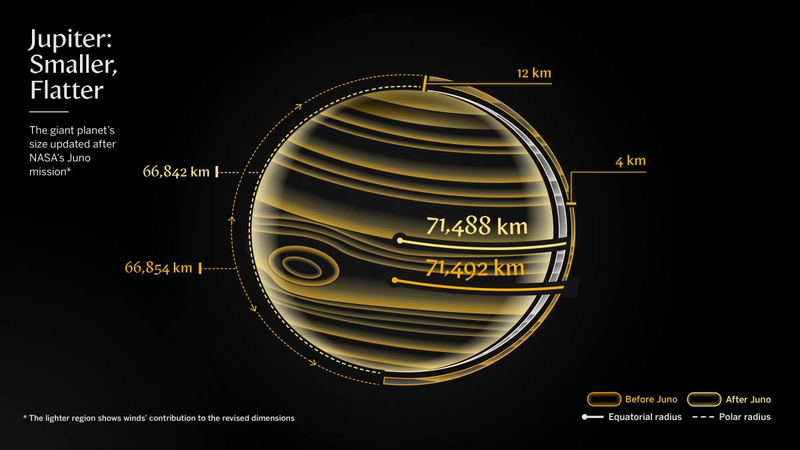
NASA's Juno mission has upended long-held assumptions about Jupiter, revealing the solar system's largest planet is slightly smaller and more flattened than previously calculated. According to research published this week in Nature Astronomy, Jupiter's equatorial radius measures 8 kilometers narrower, while its polar flattening exceeds prior estimates by 24 kilometers.
Unlocking Secrets Through Radio Signals
Scientists achieved this breakthrough using radio occultation—a technique where Juno transmitted signals through Jupiter's atmosphere during Earth-occulted flybys. These signals, received by NASA's Deep Space Network, provided unprecedented data on atmospheric density and temperature. "This geometrical configuration wasn't part of Juno's original mission plan," said lead author Eli Galanti of Israel's Weizmann Institute of Science. "The precision we achieved will redefine how we model gas giants."
Implications Beyond Our Solar System
The findings carry significance for exoplanet research. Jupiter's refined dimensions serve as a critical benchmark for interpreting transit observations of distant gas giants. As astronomers study worlds orbiting other stars, accurate models of our local giant will enhance understanding of planetary formation and atmospheric dynamics across the galaxy.
With contributions from international space agencies, Juno continues to reshape planetary science, proving even well-studied celestial neighbors can still surprise us.