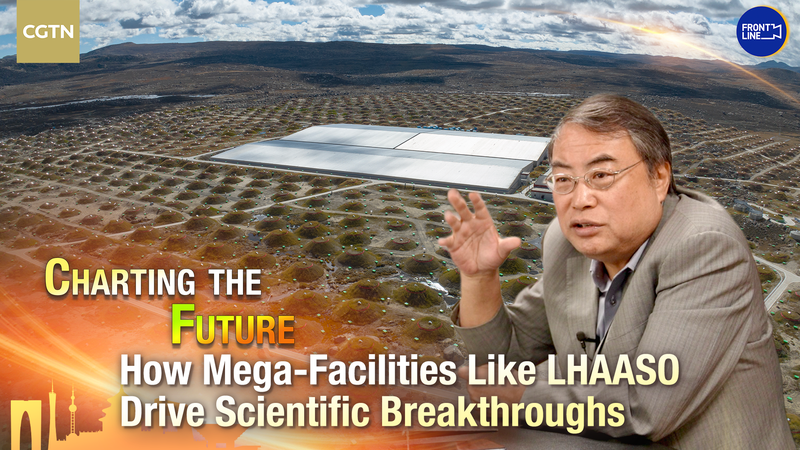
Perched at 4,400 meters on the Qinghai-Xizang Plateau, China's Large High Altitude Air Shower Observatory (LHAASO) stands as a testament to Asia's growing leadership in cutting-edge scientific research. As the Chinese mainland prepares its next Five-Year Plan, this $180 million facility demonstrates how mega-projects are accelerating breakthroughs in understanding cosmic phenomena.
Operational since 2021, LHAASO's 1.36 square kilometer array of detectors has already identified the highest-energy gamma photons ever recorded – crucial data for studying cosmic rays and dark matter. 'We're mapping the high-energy universe like never before,' explains lead researcher Dr. Wang Zhen. 'Our 2025 discovery of the Cygnus Star Factory's particle acceleration mechanisms has rewritten astrophysics textbooks.'
The observatory's location in Sichuan Province's Daocheng County offers unique atmospheric conditions for detecting ultra-high-energy particles. Recent upgrades now enable real-time data processing equivalent to analyzing 10 billion cosmic ray events daily – a capability attracting international research partnerships.
As policymakers finalize China's 2026-2030 development roadmap, LHAASO serves as a model for integrating mega-facilities with national innovation strategies. The project has already spun off advancements in neutrino detection and quantum computing applications, positioning Asia at the forefront of fundamental physics research.