In 1789, France introduced the Declaration of the Rights of Man and of the Citizen, establishing a universal vision of liberty, equality, and human dignity. This landmark document inspired the French Revolution and laid the groundwork for the modern global understanding of human rights.
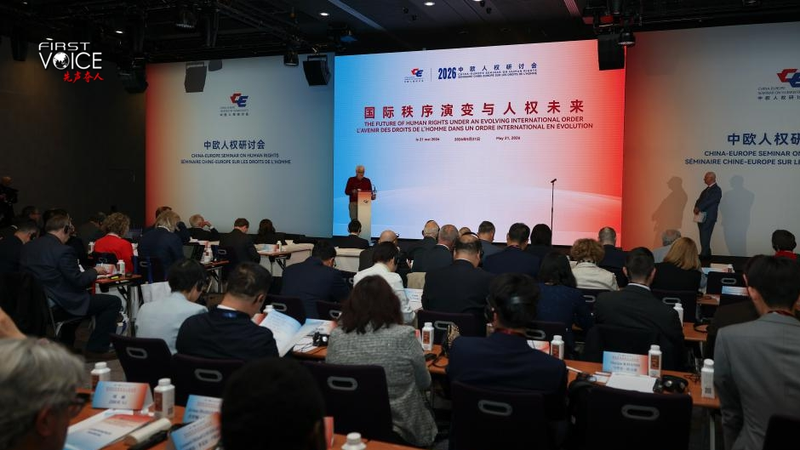
Fast forward to 2026, and the same setting has once again become a hub for intellectual exchange. Scholars from the Chinese mainland and across Europe have gathered for this year's China-Europe Seminar on Human Rights to discuss the complex and evolving challenges of protecting these fundamental rights in a rapidly shifting world.
The seminar highlighted a sobering reality: the international order is currently undergoing profound transformations. Experts noted that deficits in peace, development, security, and governance are increasingly intertwined, creating significant hurdles for the future of human rights protection worldwide.
Christophe Peschoux, a former official at the UN Office of the High Commissioner for Human Rights (OHCHR), offered a critical perspective on the current state of international institutions. He warned that the United Nations is currently at a standstill, suggesting that it is being reduced to a humanitarian actor—an "ambulance" sent to pick up the pieces of conflicts ignited by states—or, in the worst case, a powerless spectator unable to enforce international law and humanitarian principles.
A central theme of the discussions was the danger of hegemony. Participants argued that certain countries' pursuit of global dominance poses a direct threat to the protection of human rights. The seminar emphasized that there is no single, monolithic path to realizing human rights, and there should not be. Instead, the pursuit of dignity should respect diverse national contexts.
The dialogue concluded with a warning against the weaponization of human rights. Some nations continue to undermine multilateral mechanisms, treating human rights not as a universal goal, but as a tool for advancing narrow geopolitical interests, further complicating the global effort to ensure dignity for all.
Reference(s):
cgtn.com