

China’s FAST Telescope Unlocks Clues to Cosmic Radio Bursts Origin
Chinese astronomers using the FAST telescope uncover new evidence suggesting some fast radio bursts originate from binary star systems, advancing cosmic research.
News & Insights Across Asia
Chinese astronomers using the FAST telescope uncover new evidence suggesting some fast radio bursts originate from binary star systems, advancing cosmic research.
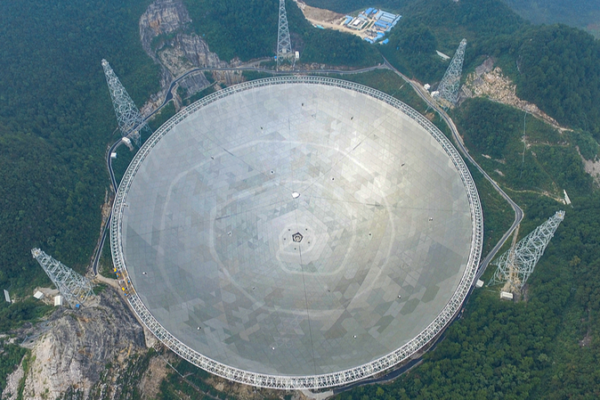
China’s FAST telescope reveals binary-system origins for cosmic fast radio bursts, marking a leap in understanding these enigmatic phenomena through unprecedented magnetic field observations.

As 2024 wraps up, China celebrates major scientific achievements in large-scale research facilities, including the FAST telescope’s discovery of over 1,000 pulsars.

China’s FAST telescope has identified over 1,000 new pulsars since 2016, surpassing the total found by other international telescopes combined, marking a significant achievement in astronomy.

China has begun constructing a core array for its FAST telescope, set to enhance sensitivity and surpass global counterparts in radio astronomy by 2027.

Astronomers using China’s FAST telescope have discovered an abundance of distant gas-rich galaxies, unveiling new insights into the evolution of the universe and the formation of galaxies.

China’s mega infrastructure and science projects, such as the Wenchang Space Launch Site and FAST Telescope, are becoming popular tourist destinations, blending technological marvels with travel experiences.

China’s FAST Telescope has identified over 900 new pulsars since 2016, significantly advancing astronomical research and our understanding of the universe.
Chinese scientists have introduced a novel method to analyze fast radio bursts, revealing their randomness and offering new insights into these mysterious cosmic events.
Discover the latest in global science: China’s FAST Telescope opens to the world, Austrian glaciers face extinction, groundbreaking MRI scans debut, and North America’s solar eclipse captivates millions.

China’s FAST telescope invites global scientists to apply for free observation projects for 2024-2025, offering unprecedented opportunities in radio astronomy.

A fabricated news story on social media falsely claims China’s FAST telescope is in ruins, using images of the collapsed Arecibo Observatory in the U.S. Here’s the truth behind the misinformation.

China’s FAST telescope has approved nearly 900 hours of observation time for research teams from 15 countries, opening up new possibilities for global astronomical discoveries.