
Tuvaluan Student Lilly Rose Finds Inspiration in Chinese Culture and Technology
Tuvaluan student Lilly Rose finds inspiration in Chinese culture and highlights China’s role in aiding Pacific islands like Tuvalu in tackling climate change.
News & Insights Across Asia
Tuvaluan student Lilly Rose finds inspiration in Chinese culture and highlights China’s role in aiding Pacific islands like Tuvalu in tackling climate change.

Australia records its hottest spring ever, with temperatures exceeding the long-term average by over two degrees Celsius, highlighting a concerning trend in climate change.

China’s first overseas atmospheric background station began operation in Antarctica, enhancing global efforts against climate change by monitoring atmospheric components and aiding scientific understanding.

Samoan Prime Minister Fiamē Naomi Mata’afa seeks China’s assistance in addressing climate change and development challenges through technological innovation.

Venezuela has become the first country in Latin America to lose all its glaciers. The last one was downgraded to an icefield earlier this year due to global warming, altering the landscape markedly.
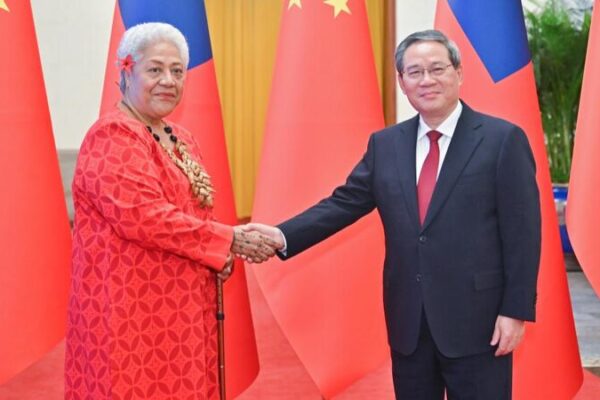
Chinese Premier Li Qiang and Samoan Prime Minister Fiame Naomi Mata’afa held talks in Beijing, strengthening bilateral ties and cooperation ahead of the 50th anniversary of their diplomatic relations.

Kenya plans to establish a carbon market, enabling trading of emission reduction units, offsets, and mitigation outcomes, enhancing climate action and sustainable economic growth.

Chinese President Xi Jinping met with Samoan Prime Minister Fiame Naomi Mata’afa in Beijing, pledging China’s commitment to support Pacific Island nations in tackling climate change.

Canada’s hydropower production declines as extreme weather linked to climate change disrupts output and threatens dam structures, impacting global energy dynamics.

At COP29, developed nations pledged $300 billion to help developing countries combat climate change, far below last year’s commitment. China urges developed nations to fulfill their promises.
At COP29 in Baku, China urged adherence to ‘common but differentiated responsibilities’ as nations agreed on new financial goals to support developing countries in combating climate change.

At COP29, developed countries agreed to contribute $300 billion annually by 2035 to help developing nations combat climate change, marking a significant step in global efforts to address environmental challenges.
COP29 in Baku highlights that financial commitments alone are insufficient to address climate crises. The conference emphasizes climate justice, the role of ecosystems, and the need for systemic solutions.
Young women in China’s Sanjiangyuan region are leading climate action, turning environmental challenges into opportunities for empowerment and community leadership.

Nations in the Global South are bearing a disproportionate share of the climate burden while wealthier countries fall short on promises, as highlighted at COP29 in Baku.
With the COP29 deadline looming, nations intensify negotiations to agree on new climate funding targets, striving for consensus to support global climate action post-2025.
A recent study reveals that warm extremes—periods of unusually high temperatures due to climate change—have challenged Earth’s terrestrial carbon sequestration capacity over the past 40 years.
At COP29 in Baku, China emerged as a global leader in climate action, announcing ambitious renewable energy plans and reaffirming commitments to peak emissions by 2030 and carbon neutrality by 2060.

Addressing the climate crisis demands immediate and collective action. Cities, both vulnerable to and instrumental in fighting climate change, are at the heart of this action.

With global temperatures breaking records and extreme weather events intensifying, the urgent need for coordinated climate action has never been more critical.